Making fresh pasta for a crowd is much easier with the right machine. The best pasta machines for large batches combine efficient dough handling, useful cutter sizes, adjustable thickness, and construction that can withstand repeated use.
This roundup includes high-powered commercial-style electric machines, automatic home models, and dependable Italian manual rollers. Use the buying guide below to match capacity, speed, cleanup, and workspace requirements to the way you cook.
Best 10 Pasta Machines for Large Batches Picks for 2026
Commercial Powerhouse
YIMOHOME 750W Electric Pasta Maker

- Up to 66 lb of noodles per hour
- Presses, kneads, and cuts dough
- Multiple cutters and adjustable thickness
Best For: Restaurants and high-volume home kitchens
Family Batch Pick
Philips 7000 Series Pasta Maker

- Makes up to 8 portions
- Ready in under 10 minutes
- Includes 8 shaping discs
Best For: Families wanting automatic homemade pasta
Classic Manual Choice
Marcato Atlas 180 Pasta Machine

- Made and assembled in Italy
- Chrome-plated steel construction
- Makes lasagne, fettuccine, and tagliolini
Best For: Hands-on home pasta making
Heavy-Duty Value
Newhai 750W Commercial Pasta Maker

- 750W press-and-cut design
- 0.12–18mm thickness adjustment
- Steel gears and stainless-steel components
Best For: Small businesses and high-volume home use
Restaurant-Ready Manual
Imperia Professional Pasta Maker

- Approximate 26-pound-per-hour output
- 10 numbered thickness settings
- Made in Italy with stainless-steel construction
Best For: Large-batch cooks wanting a durable manual roller
Commercial Electric Power

- 550W motor for repeated preparation
- 2 mm and 6 mm built-in cutters
- 0.1–5 mm adjustable sheet thickness
Best For: Commercial kitchens and large-batch dough preparation
Versatile Classic
MARCATO Atlas150 Manual Pasta Maker

- Makes lasagna, fettuccine, and tagliolini
- 10 thickness settings
- Compact 8-by-8-by-7-inch design
Best For: Home cooks needing versatile manual pasta preparation
Heavy-Duty Stainless Steel Pick

- 550W automatic motor for faster dough pressing
- Stainless steel body with heavy-duty roller
- Makes 3 mm or 9 mm noodles plus wrappers
Best For: Home and commercial kitchens needing durable noodle and wrapper production
Most Adjustable Thickness Range
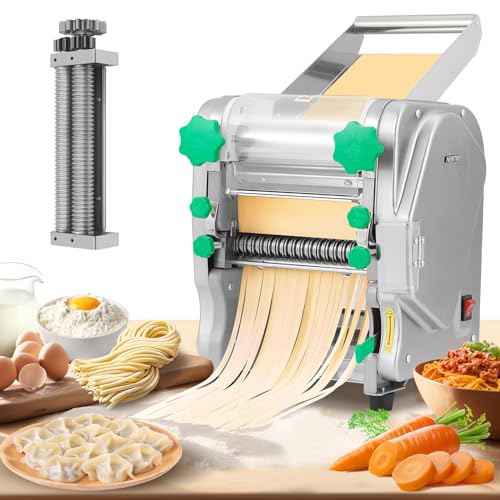
- 0.1–18 mm adjustable dough thickness
- 550W motor with 7.8-inch dough width
- Includes dual-use and round pasta blades
Best For: Users making varied pasta and wrappers with precise thickness control
Highest Stated Output
LeoneBeBe 55 lb/hr Noodle Maker

- Stated output of up to 55 lb of noodles per hour
- 3-in-1 kneading, pressing, and cutting functions
- Dual cutter makes 3 mm and 9 mm noodles
Best For: Commercial kitchens and large households prioritizing noodle throughput
Commercial Powerhouse – YIMOHOME 750W Electric Pasta Maker
For restaurants, catering, or especially demanding home kitchens, this YIMOHOME model is built for pasta machines for large batches. Its 750W motor, stainless-steel construction, dough-pressing function, and stated output of up to 66 pounds of fresh noodles per hour make it suited to high-volume preparation.
Best For: Restaurants and serious home users who need high output plus dough-sheeting versatility.
Pros:
- Rated workload of 45–66 pounds of fresh noodles per hour.
- Combines kneading, pressing, and cutting in one machine.
- Offers adjustable dough thickness from 0.1 to 20mm and multiple cutter options.
- Uses a 750W all-copper motor with stainless-steel roller and cutter components.
Cons:
- At about 46 pounds, it requires substantial counter space and storage.
- Its commercial design may be more machine than occasional pasta makers need.
- The supplied specifications contain inconsistent thickness measurements, so verify the desired setting range before purchase.
This is the most capacity-focused option in the group. Choose it when throughput, dough-sheeting capability, and heavy-duty construction matter more than compactness.
Family Batch Pick – Philips 7000 Series Pasta Maker
The Philips 7000 Series is a convenient choice among pasta machines for large batches when the goal is fresh pasta for family and friends rather than restaurant-scale production. It can prepare up to eight portions, features automatic operation, and includes eight shaping discs.
Best For: Families and home cooks who want automated, relatively hands-off batch preparation.
Pros:
- Makes up to eight portions in one batch.
- Promises fresh homemade pasta in under 10 minutes.
- Includes eight discs for varied pasta shapes.
- Non-stick, dishwasher-safe parts simplify cleanup.
Cons:
- Its 150W motor is positioned for home use rather than commercial throughput.
- Plastic components may feel less heavy-duty than the commercial steel alternatives.
- It produces extruded pasta shapes rather than the broad manual-sheeting experience of a traditional roller.
For most households, this is the easiest large-batch option to live with. Its eight-portion capacity and guided recipes favor convenience, while the included mixing function adds flexibility for other dough-based preparations.
Classic Manual Choice – Marcato Atlas 180 Pasta Machine
The Marcato Atlas 180 takes a hands-on approach to pasta preparation. It is not designed for automated high-volume output, but its chrome-plated steel body and manual rollers make it a durable option for cooks who prefer controlling each batch themselves.
Best For: Home cooks who value manual control and traditional rolled pasta over speed.
Pros:
- Manufactured and assembled in Italy.
- Chrome-plated steel construction with anodized aluminum rollers.
- Designed to make lasagne, fettuccine, and tagliolini.
- Provides 10 thickness settings for manual adjustment.
Cons:
- Manual operation requires more time and physical effort for large batches.
- Its listed functions are narrower than those of the electric machines.
- Hand washing is recommended, adding cleanup time.
The Atlas 180 is best considered a quality-focused manual alternative, not a production machine. It can handle repeated home batches, but cooks preparing very large quantities will need to trade speed for its tactile control.
Heavy-Duty Value – Newhai 750W Commercial Pasta Maker
The Newhai 750W machine targets cooks who need pasta machines for large batches without giving up adjustable dough-sheet thickness. Its press-and-cut design, steel gears, and stated 48.5-pound weight make it a substantial option for restaurant or home use.
Best For: Small food businesses and home kitchens needing a sturdy press-and-cut machine.
Pros:
- 750W motor supports efficient dough processing.
- Combines pressing and cutting without removing the blades.
- Adjustable thickness spans 0.12 to 18mm.
- Uses thickened steel construction, stainless-steel roller and feeder, and steel gears.
Cons:
- Automatically shuts down after 1–2 hours of continuous operation for cooling.
- At approximately 22kg, it is heavy and not especially portable.
- The included blade configuration is more limited than machines offering numerous cutter choices.
This Newhai balances commercial-style construction with useful thickness adjustment. The automatic cooling pause is important for production planning, but for scheduled batches in a restaurant or larger home kitchen, it offers a practical combination of power and versatility.
Restaurant-Ready Manual – Imperia Professional Pasta Maker
For pasta machines for large batches, the Imperia Professional Pasta Maker offers a durable manual setup with an 8-5/8-inch roller, 10 thickness settings, and an approximate output of 26 pounds per hour. Its Italian construction and included clamp suit cooks who prefer hands-on control.
Best For: Large-batch pasta makers who want a high-capacity manual roller for restaurant-style preparation.
Pros:
- Approximate output of 26 pounds per hour
- Ten numbered thickness settings
- Stainless-steel construction with a clamp and tray attachment
- Made in Italy with a limited lifetime warranty
Cons:
- Manual operation requires continued hand cranking
- At 9.3 kg, it is relatively heavy to move
- Its 220 mm roller may require multiple passes for very large batches
This is a strong choice when throughput and solid construction matter more than automation. The manual design gives you direct control, while the stated hourly output makes it particularly suitable for substantial pasta preparation.
Commercial Electric Power – XINGYUEXUAN 550W Pasta Maker
Among pasta machines for large batches, the XINGYUEXUAN Commercial Pasta Maker stands out for its 550W motor and semi-automatic operation. It rolls dough, adjusts sheet thickness from 0.1 to 5 mm, and cuts 2 mm or 6 mm noodles for repeated kitchen prep.
Best For: Restaurants, food-prep businesses, and serious home users making fresh pasta and other dough products in larger quantities.
Pros:
- 550W motor supports repeated rolling and cutting
- Built-in 2 mm and 6 mm cutter options
- Adjustable 0.1–5 mm roller gap
- Stainless-steel body with semi-automatic operation
Cons:
- Heavy 42.3-pound design is not highly portable
- Its 27-inch width requires substantial counter space
- Semi-automatic operation still requires feeding prepared dough
This is the most purpose-built option here for sustained production. Its motor, dual cutter widths, and broad dough applications make it practical when manual cranking would slow down larger batches.
Versatile Classic – MARCATO Atlas150 Manual Pasta Maker
MARCATO Atlas150 Manual Pasta Maker Machine-LASAGNA, FETTUCCINE & TAGLIOLINI. Made in Italy
Check Price On AmazonFor shoppers comparing pasta machines for large batches, the MARCATO Atlas150 provides a compact manual option with 10 settings and three included pasta functions. It makes lasagna sheets, fettuccine, and tagliolini while offering a 0.8–4.8 mm thickness range.
Best For: Home cooks who want a compact manual machine for several classic pasta styles and moderate batch preparation.
Pros:
- Three functions for lasagna, fettuccine, and tagliolini
- Ten thickness settings from 0.8 to 4.8 mm
- Compact 8-by-8-by-7-inch footprint
- Made in Italy with chrome- and nickel-plated steel components
Cons:
- Manual operation requires hand cranking
- Its compact roller setup may be slower for very large batches
- It does not provide the powered throughput of an electric model
The Atlas150 is a practical choice when versatility and countertop size matter more than maximum production speed. Its three pasta formats and fine thickness control make it a flexible home machine, though larger batches will take more hands-on time.
Heavy-Duty Stainless Steel Pick – INTBUYING 550W Pasta Maker
For pasta machines for large batches, the INTBUYING model combines a 550W motor with a heavy-duty dough roller and dual-purpose cutter. Its stainless steel construction and automatic operation suit kitchens that regularly prepare noodles, dumpling wrappers, or wonton skins.
Best For: Home kitchens, restaurants, canteens, hotels, and snack bars needing adjustable dough pressing and 3 mm or 9 mm noodles.
Pros:
- 550W motor is designed to reduce dough-pressing time.
- Food-grade stainless steel construction is corrosion-resistant and built for frequent use.
- Roller handles dough for dumpling and wonton skins, while the included knife makes 3 mm or 9 mm noodles.
Cons:
- Its 18-by-16-by-19-inch footprint requires substantial counter space.
- The listed sheet-thickness range is limited to 3–9 mm.
- The roller and cutter require careful handling during operation.
This is a practical option when durability and straightforward automatic production matter more than a compact footprint or highly fine thickness control. Follow the safety warning and keep hands away from moving parts while it runs.
Most Adjustable Thickness Range – NEWTRY Commercial Pasta Maker
Among pasta machines for large batches, the NEWTRY stands out for its exceptionally broad 0.1–18 mm thickness adjustment. A 550W motor, 7.8-inch dough width, and two working modes make it suited to kitchens producing varied pasta and wrapper styles.
Best For: Families and small commercial operations that want adjustable dough thickness, fettuccine, and round pasta from one machine.
Pros:
- Thickness adjusts from 0.1 to 18 mm for a wide range of dough applications.
- Includes a 2/6 mm dual-use blade and a 2.5 mm round pasta blade.
- Nylon gears are designed to reduce operating noise, with the notes listing a maximum of 68 dB.
- Pressing and cutting modes convert without removing the blade.
Cons:
- At roughly 42–45 pounds, it is not especially easy to move.
- The 7.8-inch dough width may be limiting for wider sheets.
- Its aluminum-alloy shell and stainless-steel components may require more care than an all-stainless body.
The NEWTRY is a flexible choice for buyers who value thickness control and multiple cutter options. Its moderate dough width and substantial weight are worth considering when planning a production workspace.
Highest Stated Output – LeoneBeBe 55 lb/hr Noodle Maker
For pasta machines for large batches, this LeoneBeBe electric noodle maker is the output-focused choice, with a stated capacity of 45–55 pounds of fresh noodles per hour. Its 550W motor, automatic operation, dual cutter, and dough-pressing function support both household and commercial production.
Best For: Noodle shops, breakfast businesses, snack bars, and large households that need high-volume noodles and dough skins.
Pros:
- Stated production capacity reaches 55 pounds of noodles per hour.
- Combines kneading, pressing, and cutting in one automatic machine.
- Dual cutter makes 3 mm and 9 mm noodles.
- Food-grade stainless steel body and included accessories support regular kitchen use.
Cons:
- At about 46–50 pounds, it is heavy for frequent repositioning.
- The stated dough thickness range is 0.1–5 mm, which is narrower than some adjustable models.
- Its 110V, 550W setup is intended for compatible electrical service.
This model is the strongest fit when hourly throughput is the main priority. It offers a useful combination of noodle cutting and dough sheeting, though its weight and narrower thickness range should be matched to the intended workspace and recipes.
How We Picked the Best Pasta Machines for Large Batches
We focused on the features that matter when producing multiple portions in one session: motor power, dough throughput, roller and cutter options, thickness adjustment, durability, and ease of operation. The selection includes automatic and semiautomatic machines for speed, as well as manual Italian models for cooks who prefer hands-on control.
We also considered practical details such as included accessories, footprint, cleaning requirements, voltage, and whether the machine is better suited to occasional home use or continuous restaurant-style preparation. Product specifications can vary by seller, so verify dimensions, attachments, and electrical requirements before ordering.
Quick Comparison
| Machine type | Best for | What to prioritize |
|---|---|---|
| Commercial electric | High-volume batches and frequent use | Motor strength, duty cycle, stainless-steel construction, and compatible voltage |
| Automatic home | Convenient portioned pasta with minimal handling | Mixing capacity, included shaping discs, cleanup, and app or preset controls |
| Manual roller | Traditional preparation and controlled results | Clamp stability, smooth adjustment, cutter quality, and counter space |
Key Buying Factors for Pasta Machines for Large Batches
Capacity and Motor Performance
For repeated batches, choose a machine with enough power to process firm dough without overheating or slowing down. Wattage is only one indicator; construction, gearing, ventilation, and the manufacturer’s recommended operating cycle also matter. A large hopper or broad roller can reduce the number of separate passes.
Roller Width, Thickness, and Cutters
Look for several thickness settings if you make lasagna, filled pasta, or thin noodles. Common cutter widths such as fettuccine and tagliolini are useful, while wider or dual-purpose cutters add flexibility. Check whether attachments are included or sold separately.
Materials, Cleaning, and Workspace
Stainless-steel components generally offer better durability for frequent use, but they can make a machine heavy. Measure your counter and storage area, and confirm whether parts are removable. Never assume a pasta machine is dishwasher-safe; follow the cleaning instructions to protect rollers and cutters.
Power and Operating Style
Electric machines save time but require a nearby outlet and may be louder. Manual models need more physical effort, yet they provide precise control and are often easier to store. For commercial equipment, confirm voltage and plug compatibility before purchase.
Who Should Buy Which Pasta Machines for Large Batches?
- Choose a commercial electric model if you prepare pasta frequently, need consistent output, or serve large groups.
- Choose an automatic home machine if convenience and guided portion preparation matter more than maximum throughput.
- Choose a manual Italian roller if you value control, compact storage, and traditional pasta-making technique.
- Choose a heavy-duty adjustable machine if you make several pasta styles and need interchangeable cutters or broader thickness control.
For most buyers, the best choice balances batch size with available counter space and cleanup time. A powerful commercial-style machine is not automatically the right option if you make pasta only occasionally, while a compact manual roller may become frustrating when preparing food for a crowd.