Choosing among oil presses for large batches means looking beyond motor wattage. Throughput, hopper size, temperature control, extraction consistency, and cleanup all affect how efficiently a machine performs during extended production runs.
This roundup compares 10 commercial and heavy-duty models for pressing seeds and nuts at home, on a small farm, or in a food-production setting. Use the guide below to match capacity and features to your expected workload.
Best 10 Oil Presses for Large Batches Picks for 2026
Best High-Capacity Pick
15kg/h Commercial Spiral Oil Press

- Rated for up to 15 kg (33 lb) per hour
- Heat-treated steel shaft and chamber
- Wide feed port for faster loading
Best For: High-volume seed and nut pressing
Best Versatile Option
Automatic Hot and Cold Oil Press

- Supports hot and cold pressing modes
- Rated for 9–13.5 pounds per hour
- Temperature display with 104–464°F range
Best For: Flexible home or small-commercial processing
Best Dual-Outlet Design

- Two independent 1500W motors
- Two outlets for simultaneous pressing
- Steel gears support continuous operation
Best For: Parallel or independent pressing workflows
Best for Maximum Output
1800W Automatic Seed Oil Press
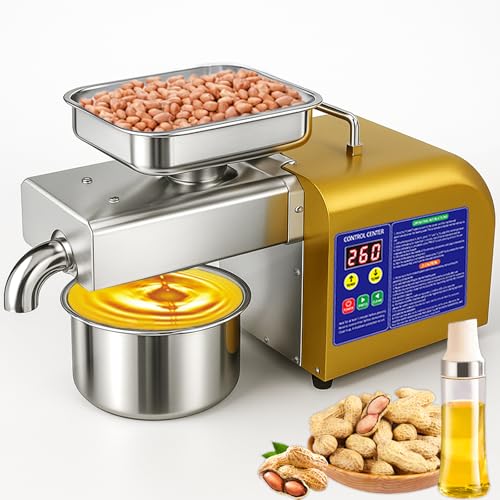
- Rated for 11–20 pounds per hour
- 1800W power and up to 24-hour operation
- Adjustable 104–572°F temperature range
Best For: High-volume automated pressing
Best Value Commercial Pick
Automatic Stainless Steel Oil Press

- 3.5–5.5 kg/h stated pressing speed
- Hot and cold pressing modes
- Adjustable temperature with stainless steel build
Best For: Regular home, farm, or small commercial batches
Highest Output Pick
1800W Continuous-Operation Oil Press

- 5–9 kg/h advertised output
- Designed for 24-hour operation
- Hot/cold modes and included cleanup kit
Best For: Sustained home, farm, workshop, or light commercial production
Feature-Rich Versatility Pick
CGOLDENWALL Automatic Oil Press

- Up to 10 lb/h for peanuts
- 32–572°F intelligent temperature control
- 304 stainless steel and auto-reversing
Best For: Varied seed and nut pressing with precise temperature control
Versatile Home-to-Kitchen Press

- Handles more than 30 types of nuts and seeds
- 304 stainless steel construction
- Automatic heating with included accessories
Best For: Heated seed and nut pressing at home or in a smaller commercial kitchen
High-Capacity Adjustable Press

- Rated for up to 11 lb per hour of flaxseed
- 122–572°F adjustable hot and cold pressing
- Designed for home, restaurant, and market use
Best For: Higher-volume pressing with adjustable temperature control
Adjustable Commercial Workhorse

- Processes a stated 3–6 kg per hour
- 50–250°C adjustable temperature range
- Stainless steel shell with automatic heating
Best For: Adjustable heated pressing of common oilseeds in regular batches
Best High-Capacity Pick – 15kg/h Commercial Spiral Oil Press
For shoppers comparing oil presses for large batches, this commercial stainless steel spiral model stands out with a stated 15 kg (33 lb) per hour capacity. Its wide feed port and dedicated oil outlet are practical features for processing larger amounts of peanuts, sesame, rapeseed, and other oil-rich seeds.
Best For: Commercial or high-volume users who want a straightforward, high-capacity press for varied seeds and nuts.
Pros:
- Rated capacity of up to 15 kg (33 lb) per hour.
- Heat-treated steel pressing shaft and chamber are designed for wear resistance.
- Wide top-loading port and dedicated oil outlet streamline batch processing.
- Supports peanuts, corn, sesame, sunflower seeds, and walnuts.
Cons:
- The listed 110V, 1500W motor and 1500W heating power may require a suitable electrical setup.
- The notes do not specify automatic temperature controls or included filtration equipment.
With the highest stated throughput in this roundup, this machine is a strong fit when capacity is the priority. Its simpler feature set may be less appealing if you need extensive automation or oil-filtration accessories.
Best Versatile Option – Automatic Hot and Cold Oil Press
This automatic model is a flexible choice among oil presses for large batches, offering hot and cold pressing modes plus a stated output of up to 9–13.5 pounds per hour. Its temperature display, programmable range, and continuous-operation claim make it suitable for users processing different raw materials over extended sessions.
Best For: Home or small-commercial users who want selectable hot and cold pressing with temperature monitoring.
Pros:
- Offers both hot-pressing and cold-pressing modes.
- Stated output reaches 9–13.5 pounds per hour.
- Intelligent panel displays and controls pressing temperature from 104–464°F.
- Includes a filter, oil cup, cleaning brush, gloves, hopper, and other pressing components.
Cons:
- The manufacturer excludes olives, cocoa beans, spices, flowers, herbs, and coffee beans.
- Its stated capacity is lower than the 15 kg/h and 11–20 lb/h models in this roundup.
- Hand-wash care may add cleanup time after large batches.
This press balances throughput with useful control over processing temperature. It is a practical middle-ground option, particularly when you value operating flexibility and included accessories more than maximum stated capacity.
Best Dual-Outlet Design – 1500W Double Oil Press
For buyers seeking oil presses for large batches with a dual-workstation design, this stainless steel model uses two independent 1500W motors and two oil outlets. The separate systems are intended to press different materials at the same time or operate independently, which can improve workflow when handling varied ingredients.
Best For: Users who want simultaneous or independent pressing capability in a commercial or domestic machine.
Pros:
- Two independent 1500W motors and two oil outlets.
- Can press different materials simultaneously without interference, according to the supplied notes.
- Four-stage steel gears are designed for continuous operation up to 24 hours.
- Advertised working noise is below 70 dB, with stated consumption of 0.5–0.6 kWh per hour.
Cons:
- The notes do not provide a pounds-per-hour or kilograms-per-hour throughput rating.
- Preheating takes about eight minutes before pressing.
- Its two-motor layout may occupy more counter or workbench space.
The dual outlets are this machine’s main advantage, especially for processing two materials or running one side at a time. Since no hourly capacity is listed, buyers focused strictly on batch throughput should compare real-world output before choosing it.
Best for Maximum Output – 1800W Automatic Seed Oil Press
This 1800W automatic press is built for shoppers comparing oil presses for large batches and prioritizing stated production speed. It claims continuous operation for up to 24 hours and an output of 11–20 pounds per hour, while its intelligent panel provides real-time temperature display and adjustable heating from 104–572°F.
Best For: High-volume users who want automatic controls, extended operation, and the highest stated output range in this selection.
Pros:
- Powerful 1800W motor with a stated output of 11–20 pounds per hour.
- Designed for continuous operation for up to 24 hours.
- Intelligent panel displays temperature and supports adjustable heating.
- Includes a filter, oil cup, cleaning brush, gloves, hopper, and pressing components.
Cons:
- Freshly pressed oil should settle for 24 hours before separation and use.
- It cannot extract olives, despite the listed reference to olive kernels.
- The manufacturer excludes cocoa beans, spices, flowers, herbs, and coffee beans.
Among these options, this model offers the strongest stated combination of power, output, and long-run operation. Its raw-material restrictions and required settling time are important considerations for anyone planning a production workflow.
Best Value Commercial Pick – Automatic Stainless Steel Oil Press
For shoppers comparing oil presses for large batches, this automatic stainless steel model offers a practical balance of throughput, hot-and-cold pressing flexibility, and continuous-duty construction. Its stated 3.5–5.5 kg/h pressing speed suits regular home, farm, or small commercial use.
Best For: Users who want a versatile automatic press for nuts and suitable seeds, with adjustable heat and straightforward cleaning.
Pros:
- Supports both hot and cold pressing, with cold pressing requiring no pre-frying.
- Adjustable temperature control and real-time display for different raw materials.
- Stainless steel construction, pure copper motor, and ventilation designed for extended operation.
- Front cover opens for easier pressing-assembly removal and cleaning.
Cons:
- It cannot press whole olives; olives require pretreatment.
- Not suitable for hard materials such as coffee beans, grape seeds, rice, or castor seeds.
- Preheating for 8–10 minutes is required before pressing.
This is a capable mid-output choice when you need more than occasional kitchen pressing but do not require the highest listed capacity. Confirm that your ingredients are approved before buying.
Highest Output Pick – 1800W Continuous-Operation Oil Press
If your priority is handling oil presses for large batches, this 1800W model has the strongest stated throughput of the three options. Its advertised 5–9 kg/h output and 24-hour continuous-operation design make it the most production-oriented choice for home, farm, workshop, or light commercial use.
Best For: Buyers who prioritize higher output, long operating sessions, and broad compatibility with common oil-bearing seeds and nuts.
Pros:
- Advertised output of 5–9 kg (11–20 lb) per hour.
- Designed for 24-hour continuous operation with a heavy-duty pressing system.
- Hot and cold pressing modes and compatibility with more than 30 seed and nut types.
- Includes a reverse function, filter, cleaning brush, glove, oil tube, and other operating accessories.
Cons:
- Its 26-pound weight and 22-inch package length may require a dedicated setup area.
- The 110V specification limits use to compatible electrical systems.
- Higher output may be more capacity than occasional household users need.
Among these options, this machine is the clearest fit for sustained batch work. The broad temperature range and included cleanup tools also make it more convenient for varied production runs.
Feature-Rich Versatility Pick – CGOLDENWALL Automatic Oil Press
The CGOLDENWALL is a strong contender among oil presses for large batches when you want a compact machine with automatic heating, broad ingredient support, and a stated pressing speed of up to 10 pounds per hour for peanuts. Its intelligent temperature controller is useful for switching between cold- and hot-pressing tasks.
Best For: Users seeking a versatile 110V press with precise temperature adjustment, auto-reversing, and a wide list of compatible seeds and nuts.
Pros:
- Advertised pressing speed of up to 10 pounds per hour for peanuts.
- Hot and cold pressing with a 32–572°F temperature-setting range.
- 304 food-grade stainless steel construction and a pure copper motor.
- Includes two pots, filter, brush, gloves, squeeze, power cable, and tool set; a two-year warranty is listed.
Cons:
- Raw materials must be sufficiently dry, and the empty machine requires preheating.
- Other ingredients should be verified with the manufacturer before pressing.
- At 29 pounds, it is less convenient to move than a lightweight countertop appliance.
This model stands out for its ingredient range and control features rather than a specifically stated continuous-duty rating. It is a sensible option for varied batch sizes when temperature precision and included accessories matter.
Versatile Home-to-Kitchen Press – DITOSH 820W Oil Press
For shoppers comparing oil presses for large batches, the DITOSH offers an 820-watt electric design with compatibility across more than 30 nuts and seeds. Its automatic heating system is intended to keep pressing straightforward, though the temperature is not adjustable and it does not support cold pressing.
Best For: Home users or smaller commercial kitchens pressing a wide range of seeds and nuts with a simple, heated process.
Pros:
- Supports more than 30 types of seeds and nuts.
- Food-grade 304 stainless steel construction is designed for rust and wear resistance.
- Includes a filter, oil cup, cleaning brush, insulated glove, and manual.
- Locking press-rod technology helps keep the rod secure during operation.
Cons:
- Temperature is non-adjustable.
- Does not support cold pressing.
- Not suitable for olive pulp, herbs, spices, flowers, coffee beans, cocoa beans, or coconuts.
The DITOSH is a practical choice when ingredient versatility and relatively simple operation matter more than adjustable pressing modes. Its included accessories and two-year warranty add convenience for regular use.
High-Capacity Adjustable Press – VEVOR 11 LBS/H Oil Press
Among oil presses for large batches, the VEVOR stands out with a stated hot-press capacity of up to 11 pounds of flaxseed per hour. Its adjustable 122–572°F range supports both hot and cold pressing, making it more adaptable to different ingredients and processing preferences.
Best For: Home, restaurant, or market users who need higher throughput and adjustable hot- or cold-pressing temperatures.
Pros:
- Rated to hot-press up to 11 pounds of flaxseed per hour.
- Offers adjustable temperatures from 122°F to 572°F.
- Supports more than 30 nuts, seeds, and oil-rich ingredients.
- Includes an oil cup, filter screen, heat-insulating gloves, and cleaning brush.
Cons:
- Listed voltage is 220 volts, so buyers should verify electrical compatibility.
- Construction combines stainless steel 201 with aluminum alloy rather than all 304 stainless steel.
- Hand-wash care is specified.
The VEVOR is the most throughput-oriented option in this group, with useful temperature flexibility for varied production needs. Confirm the 220-volt requirement before buying, especially for standard household installations.
Adjustable Commercial Workhorse – Automatic 610W Oil Press
This commercial automatic model is a compelling option for oil presses for large batches, with a stated processing range of 3–6 kilograms per hour. Its adjustable 50–250°C temperature control and automatic heating let users tailor the process for materials such as peanuts, sesame, canola, soybeans, and sunflower seeds.
Best For: Users seeking adjustable heated pressing and a stated 3–6 kg-per-hour processing range for common oilseeds.
Pros:
- Processes a stated 3–6 kg of raw material per hour.
- Temperature adjusts from 50–250°C with displayed control.
- Non-fingerprint stainless steel shell is designed for easier cleaning and corrosion resistance.
- Includes an oil cup, filter, insulation gloves, and instruction manual.
Cons:
- Product details specify hand-wash care.
- The listed motor power and product wattage information is not fully consistent.
- Supplied notes do not state a voltage, so electrical compatibility should be confirmed.
With adjustable heat and a higher stated material throughput than many home-oriented presses, this model suits users processing regular batches. Verify the electrical specifications and power details before placing an order.
How We Picked These Oil Presses for Large Batches
We focused on machines marketed for commercial, home-commercial, or continuous operation and compared their stated output, motor power, construction, heating controls, and intended use. Models with stainless-steel components, hot- and cold-press capability, adjustable temperatures, or higher throughput received particular attention because these features can matter during repeated pressing cycles.
Published capacity figures are not directly interchangeable. Actual output varies with seed type, moisture, preparation, temperature, oil content, and operator settings. Treat listed rates as useful benchmarks rather than guaranteed production figures.
Quick Comparison
| What to Compare | Why It Matters |
|---|---|
| Rated throughput | Indicates how much material the press may process per hour under stated conditions. |
| Motor power | Higher wattage can support demanding workloads, but efficiency and auger design also affect performance. |
| Temperature range | Helps accommodate different seeds and hot- or cold-pressing preferences. |
| Construction | Stainless steel is generally easier to sanitize and better suited to frequent use. |
| Operating cycle | Continuous-duty claims are important when pressing for several hours at a time. |
Key Buying Factors for Oil Presses for Large Batches
Capacity and Real-World Throughput
Start with your hourly target, then leave headroom for setup, refilling, filtering, and cleaning. A press rated around 5–9 kg per hour may suit a small commercial workflow, while larger stated capacities can reduce processing time for substantial seed volumes. Confirm whether the rating applies to the specific material you plan to press.
Heat Control and Extraction Method
Hot pressing can improve flow and extraction for some seeds, while cold pressing may better suit buyers prioritizing lower processing temperatures. Adjustable controls are more useful than a simple on/off heater, especially when switching between sesame, peanut, rapeseed, sunflower, or other materials.
Durability, Sanitation, and Maintenance
Look for stainless-steel contact surfaces, accessible pressing chambers, replaceable wear parts, and clear cleaning instructions. A machine that is difficult to disassemble can slow production and create sanitation problems. Also check whether spare augers, nozzles, seals, and heating elements are readily available.
Electrical and Workspace Requirements
Verify voltage, plug type, footprint, ventilation needs, and clearance for oil collection and expelled press cake. Higher-powered units may require a dedicated circuit. A stable work surface is essential because vibration and heat can affect both safety and consistency.
Who Should Buy Which Oil Presses for Large Batches?
Choose a higher-capacity commercial model if you process large volumes regularly and can support its electrical and space requirements. A continuous-operation model is a strong fit for extended daily runs. Buyers with varied seed types should prioritize adjustable temperature control and hot/cold flexibility. Smaller farms, restaurants, and serious home users may prefer a mid-output stainless-steel press that is easier to install and clean. Before ordering, confirm the seller’s stated capacity, warranty, replacement-part support, and return policy for your intended ingredients.