Grinding flour, corn, cereals, and other dry ingredients in volume requires more than a powerful motor. The best grain mills for large batches balance capacity, speed, grind control, durability, and cleanup.
This roundup compares 10 electric and manual options suited to different workloads, from frequent home baking to demanding farm, kitchen, and small-business use. Use the guide below to narrow your choice by batch size, available space, and preferred level of control.
Best 10 Grain Mills for Large Batches Picks for 2026
High-Capacity Electric Workhorse

- 11.89-gallon capacity for fewer refills
- 1000W motor with 19,000 rpm speed
- Five sieves for varied textures
Best For: Large household, farm, and feed-grinding batches
Controlled Kitchen Milling
NutriMill Harvest Stone Grain Mill

- 450W heavy-duty motor
- Corundum stones for stone-ground flour
- Adjustable texture-control knob
Best For: Home bakers seeking adjustable flour texture
Off-Grid Manual Option

- Six-cup hopper for extended grinding
- 12-inch flywheel eases hand operation
- Manual design can be motorized
Best For: Self-sufficient homes and backup milling
Fast Batch Processing

- 1300W motor rated at 19,000 rpm
- Up to 880 pounds per hour
- Five sieves from 2 to 8 mm
Best For: High-volume grain, spice, and feed processing
Best Compact Batch Mill
NutriMill Impact Compact Electric Grain Mill

- 1,200-watt motor for hard grains
- 8-cup hopper and 12-cup canister
- Compact nesting design with air filtration
Best For: Frequent home bread bakers needing larger flour batches
Best Versatile Bulk Grinder
VEVOR 600W Commercial Grain Pulverizer
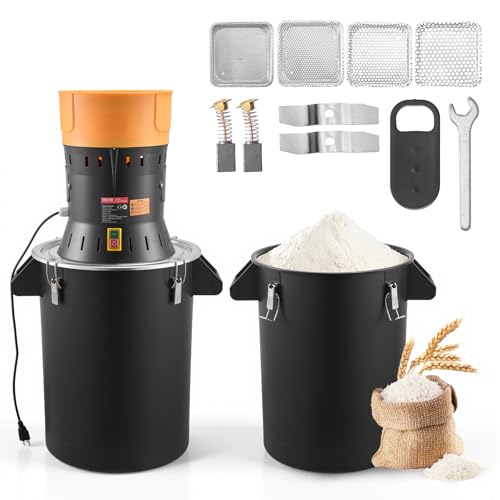
- 53-liter capacity for substantial batches
- Five screens for adjustable coarseness
- Works with grains, spices, coffee, and cereals
Best For: Farm, ranch, and home users needing multipurpose dry grinding
Best High-Power Small-Batch Mill
Jivoxia 3000g Stainless Steel Grain Mill
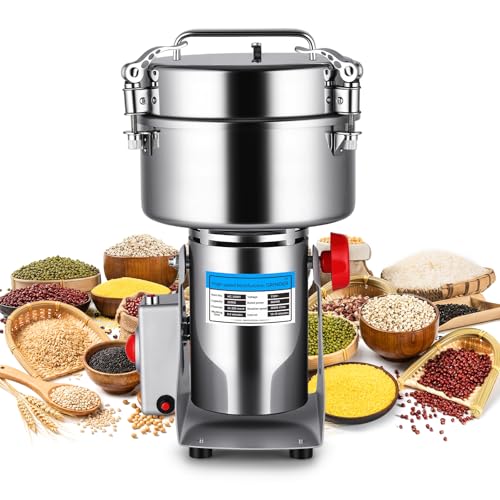
- 3,000g capacity for home or small commercial use
- 3,600-watt motor with 30-300 mesh range
- Overload protection and 270-degree swing design
Best For: Fast dry-grain and spice grinding in controlled batches
High-Capacity Farm Mill
60L Electric Grain Mill Grinder

- 60L hopper for substantial batches
- 1500W motor with six sieve sizes
- Enclosed design helps control dust
Best For: Large farms and high-volume dry-grain milling
Compact Batch Grinder
750g High-Speed Stainless Steel Mill
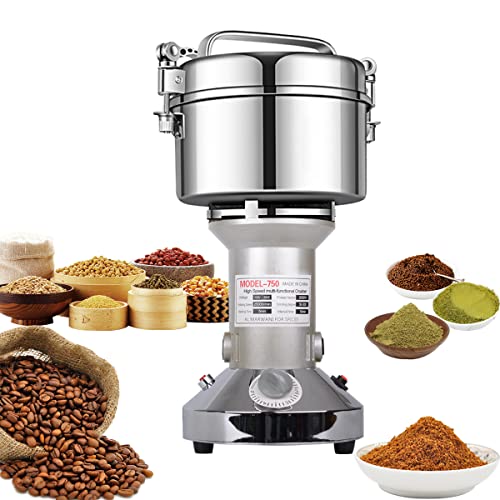
- 2000W motor for rapid dry grinding
- Stainless-steel body with overload protection
- Handles grains, spices, herbs, and coffee
Best For: Small, repeated countertop batches
Commercial Versatility Pick
VEVOR 3000W Adjustable Grain Mill

- 3000W motor for high grinding power
- Separate discs for wet and dry grinding
- Adjustable thickness and heavy cast-iron body
Best For: Commercial-style dry and wet food processing
High-Capacity Electric Workhorse – 45L Electric Grain Mill
For shoppers comparing grain mills for large batches, this 1000W electric model stands out for its 11.89-gallon capacity and continuous-feed design. Five included sieves let you choose between coarser grain, smaller particles, and powder.
Best For: Home kitchens, farms, and animal-feed applications that require high-volume grinding.
Pros:
- Large 45L capacity reduces the need for frequent refills.
- 1000W pure copper motor runs at 19,000 rpm for rapid grinding.
- Five sieves support different grinding results.
- Handles grains, beans, spices, herbs, and feed.
Cons:
- Its 14.57-by-14.57-by-33.46-inch footprint requires substantial storage space.
- The 45L hopper may be more capacity than smaller households need.
This is a practical choice when throughput and capacity matter more than compact kitchen storage. Its multiple sieves also make it more adaptable than a single-purpose flour mill.
Controlled Kitchen Milling – NutriMill Harvest Stone Grain Mill
The NutriMill Harvest is a more compact option among grain mills for large batches, pairing a 450W motor with durable corundum milling stones. Its texture-control knob lets you adjust the grind for kitchen baking and flour preparation.
Best For: Home bakers who want adjustable stone-ground flour in a relatively compact mill.
Pros:
- Near-diamond-hard corundum grainmaster milling stones are built for durability.
- Patented texture-control knob provides adjustable grinding.
- Auto-shutoff thermal protection adds a safety feature.
- CSA tested and listed; designed and assembled in the USA.
Cons:
- Its 450W motor is less powerful than the high-capacity electric models in this roundup.
- The supplied notes do not specify a large hopper capacity or hourly throughput.
This mill prioritizes controlled kitchen milling and stone-ground texture over industrial-scale capacity. It is best suited to regular home baking rather than the largest farm or feed workloads.
Off-Grid Manual Option – Lehman's Power Grain Mill
For buyers considering grain mills for large batches without relying on electricity, Lehman’s manual mill offers a six-cup hopper and a 12-inch flywheel. Its stainless steel burrs grind dry grains to pastry flour, and the unit can also be motorized.
Best For: Self-sufficient households and users who value manual control, durability, or backup milling capability.
Pros:
- Large six-cup hopper supports longer grinding sessions between refills.
- 12-inch flywheel provides momentum for easier hand grinding.
- Stainless steel burrs have a smooth, electrolytically polished surface.
- Can be motorized and bolted to a work surface.
Cons:
- Manual operation is slower and more labor-intensive than electric milling.
- At 26 pounds, it is relatively heavy for a hand-operated mill.
- It is designed for free-flowing, dry grains and similar ingredients.
This is a sturdy, flexible choice when electricity independence matters. Its six-cup capacity is useful for household batches, though users processing very large quantities should expect more hands-on effort.
Fast Batch Processing – 12-Gallon 1300W Grain Mill
This 1300W model is designed specifically for high-volume work, making it a strong contender among grain mills for large batches. It combines a 12-gallon storage drum, a stated capacity of up to 880 pounds per hour, and five interchangeable sieves for adjustable coarseness.
Best For: Fast processing of dry grains, corn, spices, cereals, coffee, and pepper in kitchens or farm settings.
Pros:
- 1300W pure copper motor reaches 19,000 rpm.
- Stated grinding capacity reaches up to 880 pounds per hour.
- Five sieves provide 2, 3, 4, 6, and 8 mm aperture options.
- Locking lid, heat-dissipation holes, handles, and nesting storage improve usability.
Cons:
- The 12-gallon design and 33.46-inch height need dedicated floor or storage space.
- Its high throughput may be excessive for occasional small-batch kitchen use.
Among these options, this model offers the clearest emphasis on speed and batch volume. The sealed hopper and compact nesting design add practical advantages, while the multiple sieves broaden its uses beyond flour.
Best Compact Batch Mill – NutriMill Impact Compact Electric Grain Mill
For bakers comparing grain mills for large batches, the NutriMill Impact Compact combines a 1,200-watt motor with an 8-cup hopper and 12-cup flour canister. Its impact milling heads are designed for fine bread flour, while the nesting design helps conserve storage space.
Best For: Frequent home bread bakers who want to process larger batches while keeping the mill compact between uses.
Pros:
- 1,200-watt motor is designed for hard grains such as wheat.
- 8-cup hopper and 12-cup canister support larger milling sessions.
- Impact milling heads produce fine-textured bread flour.
- Nesting parts and cyclone air filtration support convenient storage and airflow.
Cons:
- Its capacity is more limited than the larger commercial-style grinders in this roundup.
- The product is designed around flour milling rather than a broad range of specialty grinding tasks.
This is the most kitchen-friendly option here for regular flour production. Choose it when compact storage and bread-flour consistency matter more than maximum chamber capacity.
Best Versatile Bulk Grinder – VEVOR 600W Commercial Grain Pulverizer
The VEVOR electric grain mill is aimed at high-volume dry grinding, with a 53-liter capacity, 600-watt motor, and 15,000 RPM operating speed. Five interchangeable screens let you adjust the output for feed, flour, or spice powders, making it a flexible choice among grain mills for large batches.
Best For: Ranches, farms, and homes that need to grind substantial quantities of dry grains, spices, cereals, or coffee.
Pros:
- 53-liter capacity is suited to substantial grinding jobs.
- Interchangeable 3/4/5/6/8 mm screens provide control over coarseness.
- Handles dry grains, coffee, spices, cereals, corn, and pepper.
- Detachable hopper and feed inlet simplify cleaning.
Cons:
- Its 34.65-inch height and 18.3-pound weight require dedicated space.
- The listed 220-volt power requirement may not suit every household setup.
- It is less compact than a countertop flour-focused mill.
With its large capacity and screen options, this VEVOR model is the strongest fit for users who need versatility beyond baking flour. Confirm the electrical requirements and available floor space before buying.
Best High-Power Small-Batch Mill – Jivoxia 3000g Stainless Steel Grain Mill
The Jivoxia grain mill offers a 3,000-gram capacity and 3,600-watt motor for home or small commercial use. Its 270-degree swing design, triple-layer stainless steel blades, and adjustable 30-300 mesh range are useful for buyers seeking grain mills for large batches, though the machine requires cooling breaks during operation.
Best For: Home bakers or small cafés that want fast, superfine grinding of dry grains, coffee, and spices in batches up to 3,000 grams.
Pros:
- 3,000-gram capacity handles up to 6.6 pounds per stated batch.
- 3,600-watt motor and 30-300 mesh range support fine powder production.
- 270-degree swing design helps reduce uneven grinding.
- Overload protection automatically shuts off the motor when needed.
Cons:
- Operation is limited to three minutes before a recommended 5-10 minute cooling period.
- It must be used only with completely dry ingredients and no more than two-thirds chamber capacity.
- Cleaning requires wiping rather than rinsing with water.
This model offers high power and a useful 3,000-gram chamber, but it is not intended for uninterrupted commercial processing. Its best value is in rapid, controlled batches where fine texture and ingredient versatility are priorities.
High-Capacity Farm Mill – 60L Electric Grain Mill Grinder
For shoppers comparing grain mills for large batches, this 60-liter electric grinder is built around capacity and throughput. Its 1500W motor, enclosed grinding chamber, and included sieves make it suited to processing dry grains, spices, rice, and animal feed in farm or home settings.
Best For: Large farms and households that need a high-capacity mill for dry grain, flour, or feed.
Pros:
- Large 60L hopper capacity supports substantial grinding jobs.
- 1500W motor spins at up to 19,000 RPM for efficient milling.
- Six sieves provide multiple grinding sizes from coarse to fine.
- Sealed inlet and enclosed chamber help limit dust leakage.
Cons:
- Dry materials are required, and batch grinding is recommended.
- Overheating protection may automatically shut the unit off while grinding.
- Its 37.4-inch height and 26.5-pound weight require dedicated storage space.
This is the most capacity-focused option in the group. It makes sense when reducing repeated refills matters more than compact size, provided you follow the dry-material and cooling guidance.
Compact Batch Grinder – 750g High-Speed Stainless Steel Mill
Although its 750g chamber is smaller than other grain mills for large batches, this stainless-steel grinder can be useful when you prefer repeated countertop batches over a large hopper. The 2000W motor and three-blade setup handle dry grains, coffee, spices, herbs, and similar ingredients.
Best For: Kitchens, small businesses, and workspaces that need fast dry-ingredient grinding in manageable batches.
Pros:
- Compact 750g capacity is convenient for countertop use.
- 2000W motor can produce powder from 50 to 300 mesh in under a minute, according to the supplied notes.
- Stainless-steel construction and overload shutoff support everyday use.
- Works with grains, spices, herbs, coffee, nuts, and other dry ingredients.
Cons:
- Its 750g capacity means large jobs require multiple batches.
- Operation should be limited to about three minutes, followed by a five- to ten-minute rest.
- Wet, moist, or oily materials cannot be ground.
This model favors speed and a compact footprint rather than continuous high-volume production. It is a practical choice for smaller batches, but less suitable when minimizing reloads is the main priority.
Commercial Versatility Pick – VEVOR 3000W Adjustable Grain Mill
For grain mills for large batches that need more than dry flour production, this VEVOR model combines a 3000W motor with adjustable thickness and separate discs for wet and dry grinding. Its solid cast-iron body and funnel feed are designed for steady milling of grains, food ingredients, and feed.
Best For: Commercial-style users who want adjustable dry milling plus wet grinding for foods such as soy milk or rice cakes.
Pros:
- 3000W motor delivers high grinding power and continuous grinding capability.
- Separate cast-iron and sand milling discs support dry and wet applications.
- Adjustable thickness allows control over the grind texture.
- Stainless-steel funnel and cast-iron body are suited to heavy-duty use.
Cons:
- The industrial design is larger and less countertop-friendly than a small grinder.
- Wet and dry processing requires using the appropriate milling disc.
- The supplied notes do not specify a hopper capacity or included sieve range.
This is the strongest choice for versatility and motor power, especially if wet grinding is part of the workflow. Choose it over a simpler dry mill when adjustable texture and multiple applications justify the heavier industrial format.
How We Picked the Best Grain Mills for Large Batches
We focused on mills that can handle repeated grinding rather than occasional small portions. The comparison considers hopper or chamber capacity, motor power, stated grinding speed, sieve or texture adjustment, construction materials, cleanup features, and the type of dry ingredients each machine is designed to process.
Capacity figures and power ratings are not directly interchangeable across brands, so treat them as starting points rather than guaranteed output. Real performance depends on grain hardness, moisture, grind setting, duty cycle, and how often the machine needs to cool.
Quick Comparison
| Best For | Look For | Product Types in This Roundup |
|---|---|---|
| Frequent home flour making | Reliable electric motor, manageable size, adjustable texture | NutriMill electric models |
| Very large batches | Large hopper, high wattage, sturdy housing, cooling time guidance | 45L, 60L, 14-gallon, and commercial-style mills |
| Flexible textures | Multiple sieves or thickness adjustment | Multi-sieve electric grinders and adjustable commercial mills |
| Off-grid or backup use | Manual drive and durable flywheel | Lehman’s manual grain mill |
| Spices and fine powders | High-speed blades and sealed processing chamber | Compact stainless-steel pulverizers |
Key Buying Factors for Grain Mills for Large Batches
Capacity and Workflow
A large hopper can reduce refilling, but it also increases the machine’s footprint and loaded weight. Check whether the listed capacity refers to the hopper, grinding chamber, or total volume. For production-style use, also check whether the mill is intended for continuous operation or requires pauses between batches.
Motor Power and Grinding Mechanism
Higher wattage can help with tougher grains and faster processing, but it does not guarantee finer flour or better durability. Stone mills are often appealing for traditional flour milling and controlled output, while impact and blade-style grinders may prioritize speed and versatility. Confirm that the mechanism is rated for the ingredients you plan to use.
Grind Control and Versatility
Multiple sieves, adjustable thickness, or variable settings make it easier to switch between coarse meal, flour, and powder. If you grind spices, coffee, herbs, or oily ingredients, verify that the manufacturer permits those uses and consider how easily the chamber can be cleaned between flavors.
Cleaning, Dust, and Storage
Look for removable hoppers, detachable chambers, dust-control designs, and accessible milling parts. A large machine should have a stable storage location, adequate ventilation, and a nearby outlet capable of supporting its electrical load.
Who Should Buy Which Grain Mills for Large Batches?
Choose a compact electric mill if you want fresh flour regularly but have limited counter space. A high-capacity electric or commercial-style model is better for large family baking, food preparation, farm use, or repeated grain processing, provided you can accommodate its size and power requirements. Choose the manual Lehman’s mill when electricity is unavailable, reliability during outages matters, or you prefer a slower, hands-on process.
Before ordering, compare the mill’s stated capacity with your actual batch size, confirm compatible grains, and review safety and duty-cycle instructions. The best choice is the one that meets your required output without making cleanup, storage, or electrical demands impractical.