Making fresh apple juice or small-batch cider at home does not require a commercial-size setup. The right compact press can turn prepared fruit into juice while fitting more comfortably in a kitchen, pantry, or garage.
We compared 10 manual options across capacity, construction, handling, and storage needs to help you choose a cider press that matches your available space and batch size.
Best 10 Cider Presses for Small Kitchens Picks for 2026
Compact Crusher Pick

- 7-liter hopper for home batches
- Uniform pulp for easier pressing
- Stainless steel and reinforced iron frame
Best For: Preparing apples and pears before pressing
Traditional Home Press
4.75-Gallon Beechwood Fruit Press

- 4.75-gallon basket for home batches
- Quiet, motor-free manual operation
- Built-in pour spout for collection
Best For: Seasonal cider, juice, and wine making
Low-Effort Power Pick
5.8-Gallon Stainless Steel Press

- Hydraulic jack reduces manual effort
- 304 stainless steel construction
- Large barrels for substantial batches
Best For: High-force pressing with less hand work
Portable Traditional Pick

- Handles 6 to 8 pounds per batch
- Longer handle aims to reduce effort
- Includes one filter bag
Best For: Portable small-batch cider and juice pressing
Compact Traditional Pick
CAELUM 1.6-Gallon Manual Cider Press

- Small 1.6-gallon batch size
- Beech wood and steel construction
- Includes a pulp-separating filter bag
Best For: Small-batch home cider, juice, and wine making
Heavy-Duty Stainless Pick
Green 3.69-Gallon Fruit Wine Press

- 3.69-gallon pressing capacity
- Stainless-steel body with cross-beam
- Designed for easy hose rinsing
Best For: Larger home or small-scale fruit pressing batches
High-Capacity Classic Pick
SQUEEZE master 4.75-Gallon Press

- 4.75-gallon solid-wood press basket
- Includes a 1.8-gallon fruit crusher
- Long hand shank and gear-assisted design
Best For: Larger harvests and all-manual cider making
Compact Stainless Pick
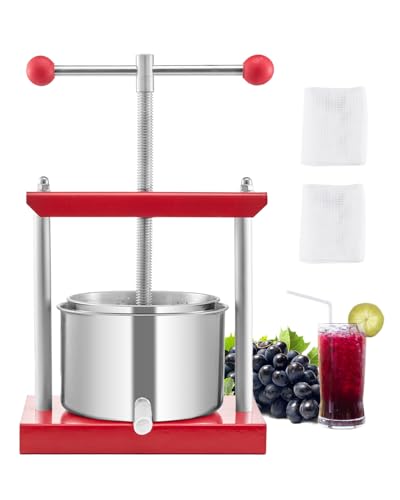
- Compact 0.8-gallon size for small batches
- Stainless steel barrels and pressing plate
- Includes two food-grade filter bags
Best For: Small-batch cider and juice making in space-conscious homes
High-Volume Home Press

- Large 3.69-gallon pressing capacity
- Removable 304 stainless steel basket
- Stable triangular base with swing-open crossbeam
Best For: Larger home batches and hobby-scale fruit pressing
Wooden Basket Favorite

- Medium 1.6-gallon capacity
- Natural beechwood basket with support blocks
- Extended handle and triangular base
Best For: Seasonal home cider batches needing medium capacity
Compact Crusher Pick – 7L Manual Fruit Crusher
For shoppers comparing cider presses for small kitchens, this manual crusher is a useful first-stage tool rather than a complete juice press. Its 7-liter hopper breaks apples and pears into uniform pieces, creating pulp that is easier to press with less waste.
Best For: Home cider makers who need a relatively compact fruit-crushing step before pressing.
Pros:
- 7-liter hopper provides useful capacity for home batches.
- Produces uniform 1/4-inch fruit pieces for easier pressing.
- Food-grade 304 stainless steel, reinforced iron frame, and table-mount components support durability.
- Manual operation works with apples, pears, grapes, oranges, and other fruit.
Cons:
- This is a crusher or scratter, not a standalone juice-extraction press.
- At 19.7 inches tall and 12.5 pounds, it still needs a stable setup and storage space.
- Hand washing is required.
Its capacity and efficient crushing make it practical for preparing fruit at home, but you will need a separate press or extraction method to turn the pulp into cider.
Traditional Home Press – 4.75-Gallon Beechwood Fruit Press
This manual fruit press is a strong option for cider presses for small kitchens when you want a traditional, motor-free setup. The 4.75-gallon beechwood basket and built-in pour spout are designed for pressing crushed apples, grapes, and berries directly into juice or wine.
Best For: Home users who want a traditional basket press for seasonal cider, juice, or wine making.
Pros:
- 4.75-gallon capacity suits family-sized seasonal batches.
- Solid red beech basket is designed to resist moisture and wear.
- Manual operation is quiet and requires no motor.
- Built-in pour spout and optional foot mounting holes support controlled, stable use.
Cons:
- Its 27.6-inch height and 24.4-inch depth require substantial floor or counter-adjacent space.
- Fruit must be crushed before loading into the press.
- Hand washing is specified for care.
The breakaway basket design can simplify pulp removal between pressing cycles, while the larger footprint makes this better for a dedicated work area than for very limited counters.
Low-Effort Power Pick – 5.8-Gallon Stainless Steel Press
Among cider presses for small kitchens, this stainless steel model stands out for its hydraulic assistance rather than its compactness. The food-grade 304 stainless steel construction, 5.81-gallon outer barrel, and hydraulic jack are aimed at extracting substantial batches with less manual effort.
Best For: Users prioritizing high pressing force and corrosion-resistant construction over minimal size.
Pros:
- Food-grade 304 stainless steel is rust-resistant and hygienic.
- Hydraulic jack delivers up to 6,613.87 pounds of pressure, reducing hand effort.
- 5.81-gallon outer barrel and 2.91-gallon filter barrel support larger batches.
- Reinforced triangular brackets are designed for stability, with a stated 330.69-pound load capacity.
Cons:
- The large capacity and reinforced frame may be less suitable for genuinely small kitchens.
- The supplied notes do not provide full dimensions or detailed cleaning instructions.
- Its hydraulic design may be more equipment than occasional users need.
This is the choice for pressing efficiency and robust construction, but confirm the available footprint before buying if storage and counter space are tight.
Portable Traditional Pick – 6L Classic Wood Press
This 6-liter classic wood press is a practical candidate for cider presses for small kitchens if portability and traditional operation matter. Its longer hand shank, thick press plate, and included filter bag are intended to make small fruit batches easier to handle.
Best For: Small-batch home users who want a portable manual press for cider, juice, wine, and similar extracts.
Pros:
- Presses 6 to 8 pounds of fruit at one time.
- Longer handle and phased pressing design are intended to reduce effort.
- Thick press plate and larger contact area aim to improve juice yield.
- Includes one filter bag and can handle fruit, pomace, and honeycomb according to the supplied notes.
Cons:
- Assembly is required.
- Its smaller batch size is less suited to high-volume pressing.
- Although described as portable, the supplied notes do not give full dimensions for storage planning.
With a manageable batch size and a labor-saving handle design, this press fits occasional home use well, especially when you value a traditional wood construction and easy relocation.
Compact Traditional Pick – CAELUM 1.6-Gallon Manual Cider Press
For shoppers comparing cider presses for small kitchens, the CAELUM offers a relatively compact 1.6-gallon format and manual operation. Its beech-wood construction, filter bag, and T-handle suit small batches of pre-chopped apples, grapes, berries, and other fruit.
Best For: Home users who want a traditional press for small-batch cider, juice, or wine making.
Pros:
- 1.6-gallon capacity is suited to smaller batches.
- Beech wood, a steel base, and corrosion-resistant hardware provide a sturdy traditional design.
- Included filter bag helps separate pulp and simplify cleanup.
- Manual pressing can reduce foam and leave drier pulp than many electric juicers.
Cons:
- Apples and pears should be chopped before pressing.
- Initial assembly of the wooden slats is required.
- Manual operation requires hands-on effort.
The CAELUM is a practical choice when countertop-friendly batch size matters more than speed. It is especially appealing for occasional seasonal pressing, provided fruit is prepared in advance.
Heavy-Duty Stainless Pick – Green 3.69-Gallon Fruit Wine Press
Among cider presses for small kitchens, this Green Fruit Wine Press is the more substantial option, with a 3.69-gallon barrel and stainless-steel construction. The heavy-duty cross-beam and screw mechanism are designed for pressing apples, grapes, berries, and other fruit with consistent manual pressure.
Best For: Enthusiasts who need larger home batches and prioritize durability and easy rinsing.
Pros:
- Stainless-steel construction is durable and designed for hygiene.
- 3.69-gallon capacity supports larger batches than compact presses.
- Heavy-duty cross-beam promotes stability during pressing.
- Can be rinsed with a hose to help prevent flavor contamination between batches.
Cons:
- Its 19-by-19-by-16-inch dimensions may be substantial for a small kitchen.
- At 33.1 pounds, it is less convenient to move than lighter presses.
- Manual pressing still requires physical effort.
This model makes sense when capacity and robust construction outweigh storage convenience. Check your available workspace carefully before choosing it for a small kitchen.
High-Capacity Classic Pick – SQUEEZE master 4.75-Gallon Press
For buyers considering cider presses for small kitchens but wanting maximum batch capacity, the SQUEEZE master combines a 4.75-gallon solid-wood basket with a 1.8-gallon fruit crusher. Its manual, gear-assisted design is intended to make pressing hard fruits and vegetables more manageable without relying on power.
Best For: Home brewers and gardeners who want an all-manual press-and-crush setup for larger harvests.
Pros:
- Large 4.75-gallon press capacity suits substantial batches.
- Included 1.8-gallon crusher helps prepare apples, pears, peaches, carrots, and other hard produce.
- Longer hand shank and spiral, phase-in pressing are designed to reduce labor.
- Food-grade stainless steel is rust resistant and durable.
Cons:
- Its larger capacity may be more than a small kitchen typically needs.
- Hand-wash-only care requires additional cleanup time.
- Manual crushing and pressing remain hands-on processes.
The SQUEEZE master is best viewed as a harvest-focused system rather than a compact occasional-use press. The integrated crusher adds versatility, while the large basket favors users processing plenty of fruit at once.
Compact Stainless Pick – 3L Fruit Wine Press
For shoppers comparing cider presses for small kitchens, this 3L stainless steel model offers a relatively compact manual setup at 8.07 by 10.24 by 13.98 inches. Its T-handle, filter bags, and removable barrels make small-batch pressing straightforward.
Best For: Home users who want a compact press for occasional cider, juice, wine, or puree making.
Pros:
- Compact 0.8-gallon capacity suits smaller batches.
- Stainless steel pressing plate, barrels, and support frame are durable and corrosion resistant.
- Includes two food-grade filter bags, and the barrels can be disassembled for cleaning.
- Manual T-handle operation requires no electricity.
Cons:
- The 3L capacity is limited for parties or larger harvests.
- Fruit should be pre-cut and works better when placed in a filter bag.
- The listed care instructions say hand wash only, despite the notes also mentioning dishwasher convenience.
This is the most kitchen-friendly option of the three when storage space and batch size matter. Choose it for modest cider runs rather than high-volume pressing.
High-Volume Home Press – 14L Stainless Basket Press
This 14L manual press is aimed at shoppers who need more output than compact cider presses for small kitchens typically provide. Its removable stainless steel basket, swinging cast-iron crossbeam, and triangular base support larger batches, though its 38.39-inch height requires substantial storage space.
Best For: Families, hobbyists, and small producers pressing larger quantities of apples, grapes, or other fruit.
Pros:
- 3.69-gallon capacity handles substantial batches.
- Removable 304 stainless steel basket simplifies cleaning.
- Cast-iron crossbeam swings open for easier loading.
- Triangular base and T-handle support stable, manual operation.
Cons:
- At 34 pounds and nearly 38.4 inches tall, it is not especially compact.
- Hard fruit should be crushed before pressing for best results.
- Food-grade lubricant is recommended on non-food-contact metal parts.
This model prioritizes capacity and stability over small-kitchen convenience. It makes sense when you have dedicated floor or storage space and regularly process larger harvests.
Wooden Basket Favorite – 6L Beechwood Fruit Press
Among cider presses for small kitchens, this 6L beechwood model sits between compact and high-capacity options. Its 1.6-gallon basket, extended handle, and triangular base offer a manageable manual setup, but the 22.64-inch height still calls for planned storage.
Best For: Home cider makers who want a medium-capacity press with a natural wood basket for seasonal batches.
Pros:
- Medium 1.6-gallon capacity balances batch size and footprint.
- Natural beechwood basket has a smooth, burr-free surface.
- One pressing block and eight supporting blocks help apply pressure efficiently.
- Includes two food-grade filter bags and a stable triangular base.
Cons:
- Hard fruit must be crushed before pressing.
- Beechwood requires hand washing and may need more care than stainless steel.
- At 15.9 pounds and 16.93 inches wide, it still needs dedicated storage.
This is a practical middle ground for households that want more capacity than a 3L press without moving up to a large 14L unit. Its wooden basket also gives it a distinctly traditional design.
How We Picked These Cider Presses for Small Kitchens
We focused on manual fruit presses with capacities suited to occasional home use, from compact 0.8-gallon models to larger presses around 5.8 gallons. Our comparison considered basket material, frame stability, pressing mechanism, cleanup, portability, and how practical each design is when counter and storage space are limited.
Capacity is important, but bigger is not automatically better. A large basket can process more fruit per batch, while a smaller unit is generally easier to store, load, and operate in a kitchen environment.
Quick Comparison
| Capacity range | Best suited to | Main advantage | Potential trade-off |
|---|---|---|---|
| 0.8–1.6 gallons | Small batches and limited storage | Compact footprint and easier handling | More pressing cycles |
| 3.69 gallons | Regular home pressing | Good balance of output and size | Needs a stable work surface |
| 4.75–5.8 gallons | Larger harvests and group use | Higher juice capacity per batch | Heavier and harder to store |
Key Buying Factors for Cider Presses for Small Kitchens
Capacity and Available Space
Measure both your storage area and working area before buying. Remember to leave room for the handle or cross-beam to move freely. For a few apples at a time, a 0.8- to 1.6-gallon press may be sufficient. Larger households or seasonal harvests may benefit from a 3.69-gallon model, provided you have a sturdy place to use it.
Basket and Frame Construction
Stainless steel baskets are durable and straightforward to clean, while solid wood baskets offer a traditional design and can feel substantial during pressing. Look for a rigid frame, reinforced supports, and a juice tray or collection area that will not flex under pressure.
Pressing Mechanism and Stability
Hand-operated screw presses are simple and do not need electricity, but they require steady downward force. T-handles, cross-beams, and long handles can improve leverage. A broad base or triangular support helps prevent movement, especially when pressing firm apples.
Preparation and Cleanup
Most presses work best when fruit is washed, cored as needed, and crushed or pulped first. If a crusher is not included, plan for a separate grinder or scratter. Removable parts and smooth, nonporous surfaces make cleanup easier and reduce the chance of trapped pulp.
Who Should Buy Which Cider Presses for Small Kitchens?
Choose a compact 0.8- or 1.6-gallon press if you make occasional juice, have limited storage, or want the easiest option to move and clean. These models suit singles, couples, and small experimental batches.
Choose a mid-size 3.69-gallon press if you regularly process garden or orchard fruit and want a practical compromise between output and footprint. It is often the most versatile size for home cider making.
Choose a 4.75- to 5.8-gallon press if you have substantial harvests or press with family and friends. Confirm that your counter, stand, or workbench can support the unit and that you have enough room to collect and store the juice.
Whichever model you select, use ripe, clean fruit, avoid overfilling the basket, and follow the manufacturer’s cleaning and food-safety instructions. A stable setup and properly crushed fruit usually matter as much as the press’s advertised capacity.