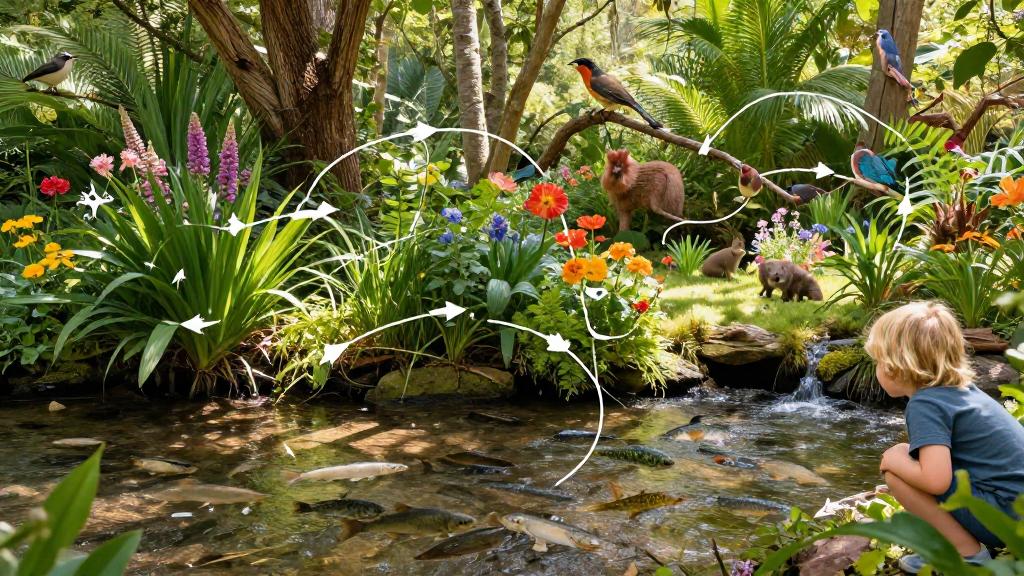
Food webs in ecosystems are complex networks that illustrate how energy and nutrients flow through various living organisms.
These intricate systems are crucial for maintaining balance within ecosystems, and understanding them is essential for anyone interested in ecology.
Let’s explore how food webs function, their components, and why they matter in the natural world.
What Are Food Webs in Ecosystems?
Food webs in ecosystems are made up of interconnected food chains that represent the feeding relationships between different organisms.
They include producers, consumers, and decomposers, all playing pivotal roles:
- Producers (Autotrophs):
– Plants
– Algae
– Some bacteria
Producers convert sunlight into energy through photosynthesis. They form the base of the food web.
-
Consumers (Heterotrophs):
– Primary consumers (herbivores) eat producers.
– Secondary consumers (carnivores) eat primary consumers.
– Tertiary consumers can be top predators, consuming secondary consumers. -
Decomposers:
– Fungi
– Bacteria
Decomposers break down dead organic matter, recycling nutrients back into the ecosystem. This process is critical for maintaining soil health and continuity in the food web.
Why Are Food Webs Important?
Food webs in ecosystems are vital for several reasons:
-
Energy Flow: They illustrate how energy moves from one trophic level to another, showcasing the relationship between plants, animals, and microorganisms.
-
Biodiversity: Food webs promote diversity as they support various species that coexist and interact, leading to a more resilient ecosystem.
-
Ecosystem Stability: A complex food web can stabilize ecosystems, enabling them to withstand changes such as climate fluctuations or species loss.
-
Nutrient Cycling: Nutrient recycling through decomposers keeps the ecosystem productive by renewing organic matter.
How Do Food Webs Get Established?
When understanding how food webs in ecosystems get established, it’s crucial to consider the initial conditions of an environment:
-
Primary Succession: This occurs in lifeless areas like a lava flow or a glacier retreat.
– Pioneer species, often lichens and mosses, start colonizing.
– As these species die, they enrich the soil, allowing larger plants to grow. -
Secondary Succession: This happens after disturbances like fires or floods, where some soil remains intact.
– Fast-growing plants return first, leading to a gradual build-up of a more complex food web.
Over time, these processes lead to a stable and diverse community, where food webs can develop.
What Are Trophic Levels and Their Role in Food Webs?
Trophic levels are the different layers in a food web:
-
Producers (Trophic Level 1):
– Base of the food web, capturing solar energy. -
Primary Consumers (Trophic Level 2):
– Herbivores that feed on producers. -
Secondary Consumers (Trophic Level 3):
– Carnivores that eat herbivores. -
Tertiary Consumers (Trophic Level 4):
– Top predators that regulate populations in the web. -
Decomposers:
– Not assigned a trophic level but are integral to breaking down and recycling nutrients.
Understanding trophic levels is essential to comprehend how energy transfer occurs and how food webs function efficiently within an ecosystem.
How Do Changes Impact Food Webs in Ecosystems?
Various factors can influence food webs in ecosystems, causing shifts or disruptions. Some important changes include:
- Invasive Species:
-
Non-native species can outcompete native ones, altering the balance of the food web.
-
Climate Change:
-
Temperature and weather changes can affect species distribution and behavior, potentially leading to mismatches between predators and prey.
-
Pollution:
-
Contaminants can accumulate in food chains, leading to toxic effects on organisms at higher trophic levels.
-
Habitat Destruction:
- Deforestation, urban development, and other activities disrupt habitats, reducing biodiversity and weakening food web connections.
How Do Scientists Study Food Webs?
To study food webs in ecosystems, scientists employ various methods:
- Direct Observation:
-
Field studies allow researchers to observe interactions between organisms in their natural habitat.
-
Food Web Modeling:
-
Computational models help simulate energy flow and the effects of changes in specific populations.
-
Stable Isotope Analysis:
-
This technique helps determine the diets of organisms and the flow of nutrients through ecosystems.
-
Ecological Surveys:
- Sampling methods involve capturing and identifying species to understand community structure and interactions.
These methods provide insights into the complexity and dynamics of food webs, aiding in conservation and ecosystem management efforts.
What Are the Effects of Human Activity on Food Webs?
Human activity significantly impacts food webs in ecosystems. Common activities leading to disruptions include:
-
Overfishing:
– This can deplete certain fish populations, leading to an imbalance in the food web. -
Agricultural Practices:
– Pesticides and fertilizers can harm non-target species, including vital decomposers. -
Urbanization:
– Developing land for cities can destroy habitats, displacing many species and reducing biodiversity. -
Global Trade:
– Introduction of invasive species through trade can shift established food webs, threatening native ecosystems. -
Climate Change:
– As mentioned earlier, it alters temperature and weather patterns, affecting migration, reproduction, and survival.
Conclusion: Why Understanding Food Webs is Essential
Food webs in ecosystems are essential for understanding ecological stability and the interconnectedness of life.
By recognizing the significance of these networks, we can better appreciate the complexity of nature and the fragility of the ecosystems that sustain us.
Preserving the balance of food webs is vital for maintaining biodiversity and ensuring healthy, functioning ecosystems for future generations.
Ultimately, as stewards of the planet, we hold the responsibility to protect these intricate webs of life, fostering a harmonious relationship between humans and the natural world.