Making doughnuts for a busy café, bake sale, party, or large family gathering requires more than a standard countertop appliance. The right machine can improve throughput, portion consistency, cleanup, and overall control.
This roundup compares 10 doughnut makers across commercial and home-use categories, including automatic fryers, batter dispensers, multi-hole electric makers, and compact mini-doughnut appliances.
Best 10 Doughnut Makers for Large Batches Picks for 2026
Best High-Output Pick
FOHERE Automatic 4-Row Mini Donut Maker

- Automates the full mini-doughnut workflow
- Produces up to 250 donuts per hour
- 304 stainless steel with temperature control
Best For: Commercial kitchens needing automated mini-doughnut production
Best Commercial Baker
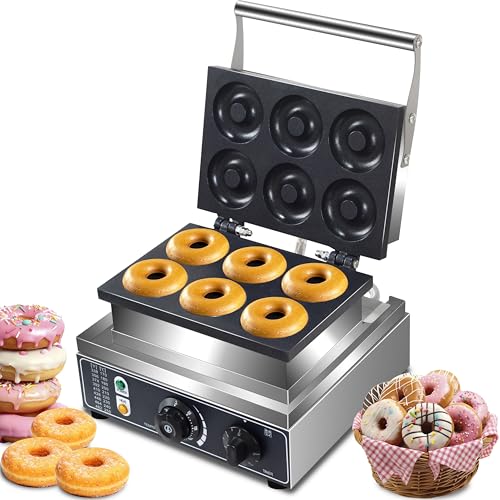
- 1600W dual-sided heating
- Adjustable 50–300°C temperature and timer
- Compact stainless steel commercial design
Best For: Small commercial kitchens baking consistent doughnuts
Best Compact Home Option

- Makes seven mini donuts per cycle
- Compact, lightweight countertop design
- Fast heating with non-stick plates
Best For: Home cooks with limited counter or storage space
Best Manual Depositor
VEVOR Large-Capacity Donut Dropper

- 2.4L hopper reduces refill frequency
- Six adjustable thickness settings
- 304 stainless steel with one-hand operation
Best For: Commercial kitchens needing controlled manual batter dispensing
Best High-Capacity Pick
Baker's Friend 12-Count Mini Donut Maker

- Makes 12 mini doughnuts per batch
- PFOA-free nonstick cooking surfaces
- Includes brush and recipe booklet
Best For: Large households, gatherings, and busy families
Best for Maximum Batch Size
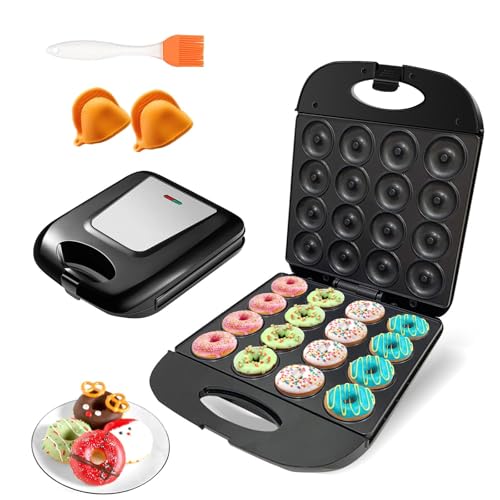
- Bakes 16 mini doughnuts per plate
- 1,400 watts with double-sided heating
- Includes mitts, brush, and user guide
Best For: High-volume home baking and entertaining
Best Compact Family Pick
KEINVE 7-Slot Mini Donut Maker

- Makes seven mini doughnuts in 4–6 minutes
- Compact design for smaller kitchens
- Nonstick plates simplify release
Best For: Small families and casual baking activities
Best Larger Mini Donuts

- Makes six 3-inch donuts per batch
- 900-watt heating with ready light
- Nonstick plates simplify cleanup
Best For: Families and hosts wanting larger mini donuts
Best High-Volume Capacity
12-Hole Commercial Donut Machine

- Bakes 12 bite-sized donuts per batch
- 1550-watt double-sided heating
- Adjustable temperature and time controls
Best For: Parties, busy kitchens, and small commercial settings
Best Kid-Friendly Option

- Makes seven mini donuts per cycle
- Simple one-setting operation
- Compact, nonstick, and easy to clean
Best For: Families and supervised kid-friendly baking
Best High-Output Pick – FOHERE Automatic 4-Row Mini Donut Maker
For businesses comparing doughnut makers for large batches, the FOHERE stands out as a fully automatic option designed for steady mini-doughnut production. Its 4-row system combines forming, frying, flipping, collecting, counting, and outputting, with stated capacity of up to 250 donuts per hour.
Best For: Cafes, bakeries, dessert shops, buffets, and other commercial kitchens needing automated mini-doughnut production.
Pros:
- Automates forming, frying, flipping, collecting, counting, and outputting.
- Four 40 mm mini-doughnut molds and a 3L hopper support high-volume production.
- 304 stainless steel construction, adjustable frying speed, and constant temperature control.
- Includes overheating protection and a double-switch start safety feature.
Cons:
- Its 21.85-by-14.76-by-14.57-inch footprint requires dedicated counter space.
- At 35.2 pounds, it is less convenient to move than a countertop home maker.
- The machine must not be operated without oil in the tank.
This is the strongest fit when throughput and automation matter more than portability. The stainless steel build and cleaning-oriented detachable design also suit frequent commercial use.
Best Commercial Baker – 6-Hole Donut Waffle Maker
This 6-hole electric baker is a practical choice among doughnut makers for large batches when you want repeatable baking without the complexity of an automatic fryer. Its 1600W dual-sided heating, adjustable temperature, and timer support consistent production across different recipes.
Best For: Bakeries, cafes, restaurants, and snack shops that need compact, repeatable baked-doughnut production.
Pros:
- 1600W double-sided heating helps bake donuts evenly.
- Temperature adjusts from 50°C to 300°C, with a 1-to-5-minute timer.
- Non-stick tray supports easier release and cleanup.
- Compact 33-by-32-by-23.5 cm design and 6.8 kg build provide stable operation.
Cons:
- Six cavities per cycle may require more batches than a multi-row automatic machine.
- It bakes doughnuts rather than automatically forming, frying, flipping, and counting them.
- The listed 110V specification may limit compatibility in some locations.
Choose this model if you prioritize baking control and a smaller commercial footprint. It offers useful recipe flexibility, though manual batter handling remains part of the workflow.
Best Compact Home Option – Dash Express Mini Donut Maker
The Dash Express is a compact alternative for shoppers who want doughnut makers for large batches at home but have limited storage or counter space. It makes seven mini donuts per cycle, heats quickly, and uses a double-sided non-stick surface for straightforward release and cleanup.
Best For: Home kitchens, dorm rooms, and families making quick batches of mini donuts.
Pros:
- Seven-donut capacity provides a convenient home-sized batch.
- Small 8.7-by-10.6-by-3.9-inch footprint and 3.3-pound weight make storage easy.
- Fast heating and a double-sided non-stick surface simplify preparation.
- PFOA-free material specification and included manual support home use.
Cons:
- Its seven-donut cycle is not intended for commercial-scale volume.
- Only one setting is listed, offering less control than commercial models.
- At 760W, it has less power than the commercial machines in this roundup.
This is the most space-conscious pick for homemade mini donuts, but large-batch users should expect repeated cycles. Its lightweight design favors convenience rather than maximum throughput.
Best Manual Depositor – VEVOR Large-Capacity Donut Dropper
For operations that already have frying or baking equipment, the VEVOR depositor is a useful component in a large-batch doughnut workflow. Its 2.4L hopper reduces refill frequency, while six thickness settings accommodate different doughnut sizes without adding an automated fryer to the setup.
Best For: Cafes, bakeries, food stands, and restaurant kitchens that need controlled manual batter dispensing.
Pros:
- 2.4L capacity supports longer runs between refills.
- Six adjustments cover widths from 55–90 mm and thicknesses from 20–30 mm.
- 304 stainless steel construction is durable and designed for straightforward cleaning.
- One-hand operation and the included stand holder support busy kitchen workflows.
Cons:
- Manual dispensing does not provide automatic frying, flipping, counting, or outputting.
- It is a batter depositor rather than a complete doughnut-making machine.
- Its capacity and settings are geared to the listed doughnut size range.
This is a flexible add-on for kitchens that want portion control and fewer hopper refills. It makes the most sense when separate cooking equipment is already available.
Best High-Capacity Pick – Baker's Friend 12-Count Mini Donut Maker
For shoppers comparing doughnut makers for large batches, this Baker’s Friend model stands out by producing 12 mini doughnuts at once. Its double-sided, PFOA-free nonstick surfaces and 1,200-watt heating system are designed for quick, even batches with simpler cleanup.
Best For: Large households, gatherings, and busy families that want 12 mini doughnuts per batch.
Pros:
- Bakes 12 mini doughnuts at a time.
- Double-sided nonstick surfaces support even cooking and easier cleanup.
- Works with cake mix, brownie mix, and other batters.
- Includes a brush and recipe booklet.
Cons:
- Produces mini doughnuts rather than full-size doughnuts.
- Its 12-inch depth and 11-inch width require dedicated counter space.
This is a practical choice when batch capacity matters most, especially for entertaining or feeding several people. The compact footprint and cool-touch feature add convenience, while the included recipe booklet helps new users get started.
Best for Maximum Batch Size – 16-Hole Mini Doughnut Maker
If your priority is maximizing output, this 16-hole electric maker is one of the more productive doughnut makers for large batches. Its 1,400-watt double-sided heating system can bake 16 mini doughnuts per plate, with a stated baking time of 1–5 minutes.
Best For: Families, entertaining, and users who want the highest mini-doughnut capacity among these options.
Pros:
- Produces 16 mini doughnuts per plate.
- Double-sided heating is designed for quick, even cooking.
- Nonstick, scratch-resistant surface helps release doughnuts easily.
- Includes mini oven mitts, an oil brush, and a user guide.
Cons:
- Each doughnut is approximately 1.97 inches in diameter, so the portions are mini-sized.
- The listed dimensions make it larger than some compact makers.
With the largest stated plate capacity in this roundup, this model is geared toward speed and volume. The included accessories are useful extras, and its compact portable design still keeps it suitable for home kitchens or other small spaces.
Best Compact Family Pick – KEINVE 7-Slot Mini Donut Maker
The KEINVE is a smaller option for shoppers who want convenient homemade treats without giving up much counter space. It makes up to seven mini doughnuts in 4–6 minutes and uses nonstick plates for straightforward release and cleanup.
Best For: Small families, children’s baking activities, and kitchens where compact storage is important.
Pros:
- Bakes up to seven mini doughnuts in 4–6 minutes.
- Nonstick plates help doughnuts release with less mess.
- Compact 8.95-by-7.37-inch footprint suits smaller kitchens.
- Supports decorating activities with icing, sprinkles, and other toppings.
Cons:
- Seven slots provide less batch capacity than the 12- and 16-slot models.
- At 750 watts, it has a lower wattage than the other listed makers.
This model is best viewed as a compact, family-friendly appliance rather than a maximum-volume machine. Its smaller batch size can work well for casual snacks, while the nonstick plates and simple format make it approachable for shared baking sessions.
Best Larger Mini Donuts – Baker’s Friend 6-Donut Maker
If you want doughnut makers for large batches but prefer larger mini donuts, the Baker’s Friend makes six 3-inch treats per cycle. Its 900-watt design heats quickly, while nonstick plates and ready/power lights keep the process simple for family gatherings and parties.
Best For: Families and hosts who want bigger-than-typical mini donuts in a compact countertop appliance.
Pros:
- Makes six relatively large 3-inch donuts at a time
- 900-watt heating with power and ready indicator lights
- Nonstick coating supports quick wipe-down cleanup
- Includes a brush, instruction manual, and recipe booklet
Cons:
- Six-donut capacity is lower than commercial-style 12-hole models
- Designed for mini donuts rather than full-size donuts
This is a practical middle ground for entertaining: it offers more substantial portions than tiny mini-donut makers without taking up much counter space.
Best High-Volume Capacity – 12-Hole Commercial Donut Machine
For shoppers comparing doughnut makers for large batches, this 12-hole commercial-style machine offers the highest stated capacity in the group. Its 1550-watt system uses double-sided heating and adjustable temperature and time controls to produce multiple bite-sized donuts efficiently.
Best For: Busy households, parties, cafes, and other settings where batch capacity and speed matter most.
Pros:
- Bakes 12 bite-sized donuts at once
- 1550 watts and double-sided heating support fast, even baking
- Temperature adjusts from 50–300°C with separate time control
- Nonstick plates and stainless steel/aluminum construction
Cons:
- At 19.8 pounds, it is substantially heavier than home mini models
- Its commercial-style size may be less convenient for occasional use
- Produces bite-sized donuts rather than larger 3-inch portions
If throughput is your priority, this is the strongest fit of the three. The larger footprint and heavier build are trade-offs for its 12-donut capacity and higher power.
Best Kid-Friendly Option – Dash 7-Donut Mini Maker
The Dash Mini Donut Maker is a straightforward choice for families seeking doughnut makers for large batches on a smaller household scale. It makes seven mini donuts per cycle, uses a simple one-setting design, and has nonstick cooking surfaces that make cleanup easy after breakfast or snack time.
Best For: Families with children who want an easy, compact appliance for frequent mini-donut treats.
Pros:
- Makes seven mini donuts within minutes
- Simple operation suitable for kids with supervision
- Nonstick surface supports easy cleanup
- Compact 2.2-pound design with a one-year warranty
Cons:
- Lower capacity than the 12-hole commercial model
- Only one listed setting limits adjustment options
- Makes mini donuts rather than larger donuts
Its seven-donut capacity is useful for small family batches, while the lightweight body and uncomplicated controls make it especially approachable for kid-focused baking.
How We Picked the Best Doughnut Makers for Large Batches
We focused on the features that matter when producing repeated batches: capacity, output, heating performance, portion consistency, ease of use, cleanup, and intended setting. Commercial models were assessed for throughput and adjustability, while home machines were compared for batch size, footprint, simplicity, and everyday convenience.
Because “large batch” can mean different things, this list includes both high-volume equipment and compact machines that cook several doughnuts at once. A home baker may value quick plug-in operation, while a food business may need a hopper, depositor, or fryer designed for continuous use.
Quick Comparison
- Highest-volume option: Look for an automatic commercial fryer with a large hopper, multiple rows, and intelligent temperature or timing controls.
- Best for manual portion control: A stainless-steel doughnut depositor offers adjustable dispensing and can pair with a fryer or cooking surface.
- Best for baked mini doughnuts: Multi-hole electric makers provide consistent shapes without deep frying.
- Best for occasional home use: Compact seven- or 12-cavity machines are easier to store and operate.
- Best for entertaining: Choose a model with the largest practical cavity count and a fast recovery time between batches.
Key Buying Factors for Doughnut Makers for Large Batches
Capacity and Output
Check both the number of cavities and the stated hourly output. A 16-hole baker may be convenient for repeated baked batches, while a commercial fryer rated for hundreds of pieces per hour is better suited to events or business use. Confirm whether capacity refers to mini doughnuts, standard-size doughnuts, or theoretical maximum production.
Heating and Temperature Control
Even heating helps prevent pale centers, burnt edges, and inconsistent texture. Adjustable temperature controls are especially important for different batters and recipes. Commercial equipment should also offer enough power to recover quickly after loading a new batch.
Portioning and Dough Consistency
Uniform batter portions produce evenly sized doughnuts and more predictable cooking times. Machines with built-in hoppers or adjustable depositors can reduce manual work. If using a separate dispenser, check its adjustment range, capacity, and compatibility with your batter thickness.
Cleaning, Safety, and Workspace
Non-stick cooking plates simplify cleanup, but removable parts and accessible surfaces are valuable for frequent production. For fryers, consider oil handling, splash protection, ventilation, and safe placement. Measure counter space and storage height before buying, particularly for commercial machines.
Who Should Buy Which Doughnut Makers for Large Batches?
Choose a commercial automatic fryer if you operate a café, concession stand, bakery, or event business and need sustained production with minimal manual handling. Choose a manual depositor if flexibility and portion control matter more than automation.
Choose a multi-hole electric maker for home baking, parties, classrooms, and small catering jobs where baked mini doughnuts are preferable to fried ones. Choose a compact seven-hole model if storage space and simple operation are priorities. For frequent large batches at home, favor higher cavity counts, strong wattage, durable plates, and reliable temperature control over decorative features.