Choosing the best grain mill for long-term food storage means balancing preparedness, daily usability, grinding capacity, and backup reliability. The right model can turn stored wheat, corn, oats, rice, and other dry grains into fresh flour when you need it.
This roundup compares 10 manual and electric grain mills, from compact countertop machines to heavy-duty grinders and hand-crank designs. Use the guide below to match your storage plan, power situation, and preferred workload with the most practical mill.
Best 10 Grain Mill for Long Term Food Storage Picks for 2026
Most Versatile Manual Mill

- Stone and stainless steel burrs
- Handles grains, nuts, seeds, and oily foods
- Produces up to 1.25 cups per minute
Best For: Flexible hand-powered milling and specialty ingredients
Best Traditional Corn Mill
Victoria Manual Cast Iron Mill

- Durable cast iron construction
- 2,400-gram high hopper
- Clamps to tables 1/2 to 2 inches thick
Best For: Corn, coarse grains, and general-purpose manual grinding
Highest-Output Electric Mill

- 3000W motor for continuous grinding
- Supports dry and wet milling
- Adjustable thickness control
Best For: High-volume electric grinding and wet food processing
Best Large-Capacity Manual Mill

- Six-cup hopper for larger batches
- 12-inch flywheel eases hand grinding
- Grinds dry grains to pastry flour
Best For: Bulk manual milling and home baking
Best Manual Tabletop Pick
VEVOR Low-Hopper Hand-Crank Grain Mill

- Electricity-free grinding for preparedness
- Adjustable texture for grains and spices
- Clamp and dust cover support cleaner use
Best For: Small-batch home and emergency grinding
Best High-Speed Electric Pick
OKF 750g Stainless Steel Grain Mill

- 2800W motor rated at 28,000 rpm
- Adjustable timer and 70- to 300-mesh fineness
- Processes dry grains, spices, herbs, and coffee
Best For: Fast electric milling of dry ingredients
Best Large-Hopper Manual Pick

- Manual operation for off-grid preparedness
- 1.3 kg capacity with a large hopper
- Adjustable grinding for flour, meal, and spices
Best For: Larger manual batches in home or survival setups
Best Overall
NutriMill Impact Compact Grain Mill

- 1,200-watt motor for hard grains
- Large hopper and flour canister
- Compact nesting design
Best For: Frequent bread baking and larger wheat-flour batches
Best High-Capacity
1000g Commercial Grain Grinder

- 3,000-watt, 32,000-RPM motor
- 1,000g stainless steel chamber
- 70-300 mesh adjustment
Best For: Bulk dry grinding with adjustable powder fineness
Best Budget-Friendly
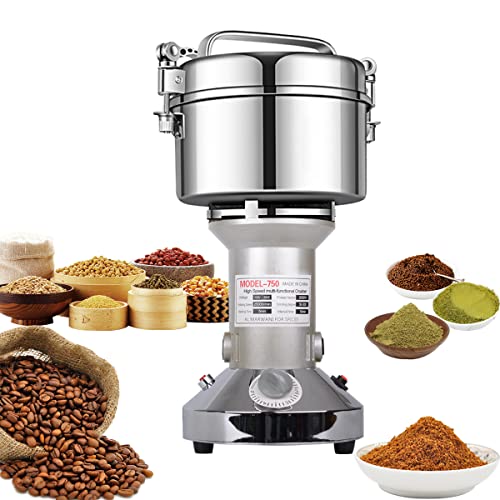
- 2,000-watt, 25,000-RPM motor
- 750g capacity for moderate batches
- 50-300 mesh texture range
Best For: Home grinding of varied dry grains, spices, and herbs
Most Versatile Manual Mill – WonderMill Junior Deluxe
For a grain mill for long term food storage, the WonderMill Junior Deluxe is a flexible manual option that can process dry grains, moist foods, oily ingredients, nuts, seeds, and spices. Its dual burr setup and precise locking adjustment make it useful for both fine flour and coarse cracked grains.
Best For: Preppers and home cooks who want one hand-powered mill for grains, specialty ingredients, nut butter, and spices.
Pros:
- Can produce up to 1.25 cups of flour per minute.
- Includes stone and stainless steel burrs for dry, oily, and higher-moisture foods.
- Heavy-duty aluminum construction and a secure double-clamp table mount.
- Locking adjustment knob maintains the selected grind setting.
Cons:
- At 14 pounds, it is heavier than some compact manual mills.
- Manual cranking requires physical effort for larger batches.
This is the strongest all-around choice when versatility matters as much as flour production. It is especially useful for storage plans that include grains plus nuts, seeds, spices, or other ingredients electric mills may not handle.
Best Traditional Corn Mill – Victoria Manual Cast Iron Mill
The Victoria Manual Cast Iron Grain Mill is a straightforward choice for a grain mill for long term food storage when you prioritize durable construction and simple operation. Its high hopper holds up to 2,400 grams, while the adjustable screw lets you change the grind from coarse to finer textures.
Best For: Users focused on corn, barley, coarse grains, coffee, seeds, nuts, and other general-purpose grinding tasks.
Pros:
- Heavy-duty cast iron body with double tin plating.
- High hopper provides a 2,400-gram capacity.
- Clamps to tables 1/2 to 2 inches thick and includes a non-slip protector.
- Adjustable screw supports different coarseness levels.
Cons:
- Cannot produce a superfine texture or fine whole-wheat powder.
- Includes only a 90-day limited warranty.
This mill suits storage plans centered on corn and coarse milling rather than fine baking flour. Its traditional cast iron design is practical for basic, repeatable grinding, but the texture limitation is important if you regularly make bread or pastry.
Highest-Output Electric Mill – VEVOR 3000W Grain Grinder
For a grain mill for long term food storage with high-volume needs, the VEVOR 3000W Electric Grain Mill provides powered grinding and adjustable thickness control. It includes separate discs for dry grinding and wet milling, allowing it to process grains, crops, soaked soybeans, and rice into powder or pulp.
Best For: Households or small food-production settings that need continuous electric grinding for dry grains, wet ingredients, and feed.
Pros:
- Powerful 3000W motor supports continuous grinding.
- Includes cast iron and sand milling discs for dry and wet applications.
- Adjustable thickness works with grains, coffee, spices, nuts, and cereal.
- Stainless steel funnel and solid cast iron body are designed for prolonged use.
Cons:
- Large 19.88-by-9.84-by-27.56-inch footprint requires substantial storage space.
- Requires electricity, making it less suitable for outages without backup power.
- Its industrial design may be excessive for occasional household milling.
This is the productivity-focused option in the group. It is compelling when speed and wet/dry versatility outweigh portability, but long-term emergency storage plans should account for its electrical requirement and large footprint.
Best Large-Capacity Manual Mill – Lehman's Power Grain Mill
The Lehman’s Manual Power Grain Mill is a strong candidate for a grain mill for long term food storage when batch size and manual efficiency are priorities. Its six-cup hopper and 12-inch flywheel provide substantial capacity and added momentum, while stainless steel burrs can grind free-flowing dry grains to pastry flour.
Best For: Bulk home baking and self-sufficiency with wheat, corn, rye, rice, quinoa, and small beans.
Pros:
- Large six-cup hopper reduces frequent refilling.
- 12-inch iron V-belt flywheel helps make hand grinding easier.
- Stainless steel burrs can produce pastry flour from dry grains.
- Can be motorized and has four pre-drilled mounting holes.
Cons:
- At 26 pounds and 14 inches high, it is bulky and heavy.
- Designed for free-flowing dry grains rather than wet or oily ingredients.
- Requires bolting for a more permanent installation if using the base holes.
This mill is well suited to a dedicated food-storage or baking station. Its larger hopper and flywheel make it more practical for repeated batches than many compact hand mills, provided you have room for its substantial frame.
Best Manual Tabletop Pick – VEVOR Low-Hopper Hand-Crank Grain Mill
For shoppers seeking a grain mill for long term food storage, this VEVOR manual model offers an electricity-free way to process small batches of wheat, corn, spices, coffee beans, and nuts. Its adjustable grinding disc lets you control texture, while the table clamp helps keep the mill steady during use.
Best For: Small-batch grinding at home, during power outages, or in preparedness setups where a compact manual mill is useful.
Pros:
- Works without electricity and helps limit heat buildup during grinding.
- Adjustable disc supports coarser or finer results, with repeat passes for a finer texture.
- Cast-iron construction, secure table clamp, and included dust cover support stable, cleaner operation.
Cons:
- The low hopper is designed for small batches rather than high-volume milling.
- Manual cranking requires more hands-on effort than an electric mill.
This is a practical choice when resilience and simplicity matter more than speed. The clamp and adjustable settings add useful control, but its small-batch design is best suited to regular household preparation rather than large-scale stockpiling.
Best High-Speed Electric Pick – OKF 750g Stainless Steel Grain Mill
This 750g OKF machine is a high-speed option for shoppers comparing a grain mill for long term food storage. Its stainless-steel body, 2800W motor, timer, and stated 70- to 300-mesh range are designed for quickly pulverizing dry grains, spices, herbs, and coffee beans.
Best For: Users who prioritize fast electric processing and very fine results for dry ingredients.
Pros:
- High-speed 2800W motor is rated at 28,000 rpm for rapid grinding.
- Stainless-steel construction is intended for durable, food-focused use.
- Timer-based control and a stated 70- to 300-mesh range provide adjustable fineness.
Cons:
- It requires 110V electricity, so it is less suitable for power-outage use without backup power.
- Continuous grinding should not exceed five minutes, followed by a 5- to 10-minute cooling period.
- The motor housing should not be rinsed directly with water.
This model is better suited to efficient batch processing than off-grid milling. Its 750g capacity and fast motor can save time, but long-term storage users should plan around the cooling intervals and electricity requirement.
Best Large-Hopper Manual Pick – Heavy-Duty Hand Grain Mill
For a grain mill for long term food storage that does not depend on electricity, this heavy-duty hand mill combines a large hopper with adjustable stainless-steel grinding discs. It can handle dry grains, beans, spices, herbs, nuts, and coffee, making it a versatile option for home, camping, and survival use.
Best For: Preparedness-minded users who want a large-capacity manual mill for varied dry ingredients.
Pros:
- Manual operation works without electricity for backup and off-grid use.
- Large hopper and 1.3 kg listed capacity support more substantial batches than compact hand mills.
- Adjustable grinding and a large flywheel help produce textures from grist to fine flour.
- Stainless-steel discs and a dismantlable design support food-safe use and easier cleaning.
Cons:
- At 28.6 pounds, it is considerably heavier and less portable than smaller manual mills.
- It is limited to dry materials and cannot process wet, oily, or sticky ingredients.
- The large footprint may require dedicated counter or storage space.
This is the strongest fit here for users who want manual capacity and broad ingredient compatibility. Its size and weight favor a stationary preparedness setup, while the adjustable grind makes it useful for both flour and coarser meal.
Best Overall – NutriMill Impact Compact Grain Mill
For shoppers seeking a grain mill for long term food storage, the NutriMill Impact Compact focuses on efficient batch milling and convenient storage. Its 1,200-watt motor and impact milling heads are designed for hard grains such as wheat and producing fine bread flour.
Best For: Frequent bread bakers and households that want a compact electric mill for larger flour batches.
Pros:
- 1,200-watt motor handles hard grains such as wheat.
- Impact milling heads are designed for fine, consistent bread flour.
- 8-cup hopper and 12-cup flour canister support larger batches.
- Nesting components and cyclone air filtration simplify storage and operation.
Cons:
- Designed around electric operation, so it requires access to power.
- Its bread-flour-focused design may be less versatile than a multipurpose pulverizer.
This is the most purpose-built option of the three for regularly turning stored wheat into baking flour. The integrated hopper, canister, and compact nesting design make it especially practical when storage space and batch capacity both matter.
Best High-Capacity – 1000g Commercial Grain Grinder
This commercial-style grinder is worth considering if your grain mill for long term food storage needs to process substantial dry batches quickly. It combines a 3,000-watt motor, 1,000-gram stainless steel chamber, and adjustable 70-300 mesh control for textures ranging from coarse particles to very fine powder.
Best For: Bulk dry-ingredient preparation for households, bakeries, restaurants, and users who want adjustable fineness.
Pros:
- High-power 3,000-watt motor reaches up to 32,000 RPM.
- 1,000-gram stainless steel chamber supports larger batches.
- Adjustable 70-300 mesh settings provide broad texture control.
- Lid lock, automatic cover shutoff, overload protection, sieve, and cleaning tools add practicality.
Cons:
- Suitable only for dry ingredients; wet, oily, and sticky foods are not recommended.
- Its 8.7-by-8.7-by-16.2-inch footprint is less compact than a small countertop mill.
- The high-speed motor may be more capability than occasional users need.
With the largest stated capacity and the widest fineness range in this group, this model suits users preparing flour, cereal powder, spices, coffee, or other dry ingredients in bulk. It is a versatile choice, provided your stored foods are thoroughly dry.
Best Budget-Friendly – 750g High-Speed Grain Grinder
If you need a grain mill for long term food storage that can handle varied dry ingredients, this 750-gram stainless steel grinder offers high-speed pulverizing in a relatively compact body. Its triple-blade system and 50-300 mesh range can process grains, coffee, spices, herbs, and other dry foods.
Best For: Home users who need a multipurpose dry grinder and are comfortable working in short cycles.
Pros:
- 2,000-watt motor and 25,000 RPM speed provide fast grinding.
- 750-gram capacity suits moderate-size batches.
- Triple-blade design and 50-300 mesh fineness support varied dry ingredients.
- Overload shutoff and a lid-lock requirement add safety protection.
Cons:
- Operation should be limited to three minutes, followed by a 5-10-minute rest.
- Only dry materials are suitable; wet, moist, or oily ingredients cannot be ground.
- Cleaning requires wiping rather than rinsing, and the motor must be kept dry.
This model offers broad ingredient flexibility but demands more attention to operating intervals and cleanup. It is a reasonable fit for smaller households building a dry-food grinding setup, rather than users who need uninterrupted commercial-style processing.
How We Picked the Best Grain Mill for Long Term Food Storage
We focused on the factors that matter most for emergency preparedness and repeated home use: power requirements, manual backup capability, hopper and batch capacity, construction, grind adjustability, cleanup, and the types of dry foods each mill is designed to handle. The list includes hand-operated cast-iron mills for off-grid reliability, electric impact mills for speed, and high-powered pulverizers for larger batches.
Because product specifications can vary by seller and model version, verify the included accessories, voltage, maximum capacity, and permitted ingredients before purchasing. Oily foods, wet ingredients, and very hard grains may require a mill specifically rated for them.
Quick Comparison
- Best for power outages: Manual mills such as the WonderMill Junior Deluxe, Victoria, Lehman’s, and VEVOR hand-crank models.
- Best for speed: Electric impact and high-speed stainless-steel grinders.
- Best for larger batches: High-capacity commercial-style electric mills and the Lehman’s model with its large hopper.
- Best for compact kitchens: NutriMill’s compact electric design and smaller-capacity countertop grinders.
- Best for versatility: Models rated for multiple dry grains, seeds, spices, or oily foods rather than wheat alone.
Key Buying Factors for a Grain Mill for Long-Term Food Storage
Manual or Electric Operation
A manual mill remains usable during outages and avoids batteries, generators, or electrical noise, but grinding takes physical effort and time. Electric mills are faster and better for routine baking, though they depend on stable power. Many preparedness-minded buyers keep a manual mill as a backup even when their primary machine is electric.
Capacity and Batch Size
Consider how much flour you need at once. A smaller hopper may suit occasional baking and easier storage, while a large-capacity or commercial-style grinder is more practical for feeding a household or processing a substantial supply of stored grain. Do not judge capacity by motor wattage alone; check the rated batch size and recommended duty cycle.
Grind Control and Food Compatibility
Adjustable settings are useful for switching between coarse meal, flour, and pastry-like textures. Confirm that the mill supports your staple foods, especially hard wheat, corn, rice, oats, seeds, or spices. Some high-speed pulverizers are intended for dry ingredients only and may not replace a purpose-built grain mill.
Durability, Maintenance, and Storage
Cast-iron bodies offer stability and longevity but can be heavy and may require careful drying to prevent rust. Stainless-steel components are easier to clean, while stone or specialized milling heads may provide useful texture control. Look for secure clamps, sturdy bases, accessible grinding parts, and replacement components.
Who Should Buy Which Grain Mill for Long Term Food Storage?
Choose a manual grain mill if outage readiness, independence, and long-term durability matter most. Choose a compact electric mill for everyday fresh flour in a smaller kitchen. Choose a high-capacity electric grinder if you regularly process large batches and have dependable power. For the most resilient setup, pair an electric mill with a dependable hand-crank model and store both with sealed grain, cleaning supplies, and clearly labeled instructions.