Grinding your own gluten-free flour can improve freshness, expand your ingredient choices, and help you control how finely grains, seeds, and other dry ingredients are processed. The right mill depends on more than motor power: capacity, cleanup, noise, and compatibility with your preferred ingredients all matter.
We’ve gathered 10 options ranging from compact electric grinders to stone and manual mills. Use the guide below to compare their practical differences and choose a model that fits your baking routine, available space, and batch size.
Best 10 Grain Mill for Gluten Free Flour Picks for 2026
Fast Fine-Grind Pick
Goldtouch 150g Electric Grain Mill

- 1500W motor with three blades
- 150g capacity for quick batches
- Safety interlock and overload protection
Best For: Small-batch dry grains, spices, and gluten-free flour
Premium Stone-Milling Choice
NutriMill Harvest Electric Stone Grain Mill

- Near-diamond-hard Corundum stones
- Adjustable pastry flour to cracked grain
- 5-cup capacity with thermal protection
Best For: Regular home bakers seeking adjustable stone-milled flour
High-Capacity Power Pick
750g Stainless Steel Grain Mill

- 750g capacity for larger batches
- 2800W motor with timer control
- 70- to 300-mesh stated fineness range
Best For: High-volume dry grain and flour processing
Traditional Manual Option
Stone Grain Mill with Wooden Stand

- Manual stone grinding with no motor
- Supports dry and wet grinding
- Includes filter bag, brush, and wooden frame
Best For: Hands-on small-batch grinding of grains, seeds, and beans
Best for Easy Setup
3000W 1000g Electric Grain Mill

- 1000g chamber for larger batches
- 70–300 mesh grinding range
- Timer and overload protection
Best For: Large-batch flour and dry-ingredient grinding
Most Versatile Home Option

- 50–300 mesh texture adjustment
- 1800W motor with 25,000 RPM speed
- Safety lock and overload protection
Best For: Flexible home flour, spice, and dry-food grinding
Compact Batch Pick

- Small 150g chamber for fresh batches
- 30–300 mesh fineness control
- 850W motor with safety lock
Best For: Small households and occasional flour grinding
Fast Family-Batch Pick
550g High-Speed Stainless Grain Mill

- 2000W motor with 28,000 RPM operation
- 70-300 mesh range for flexible textures
- 304 stainless steel chamber and blades
Best For: Fast small-to-medium batches of gluten-free flour at home
Compact Baking Specialist

- 1200W motor handles hard grains
- Impact heads produce fine, consistent flour
- 8-cup hopper and 12-cup canister
Best For: Frequent bakers making larger batches of fresh flour
Large-Batch Workhorse
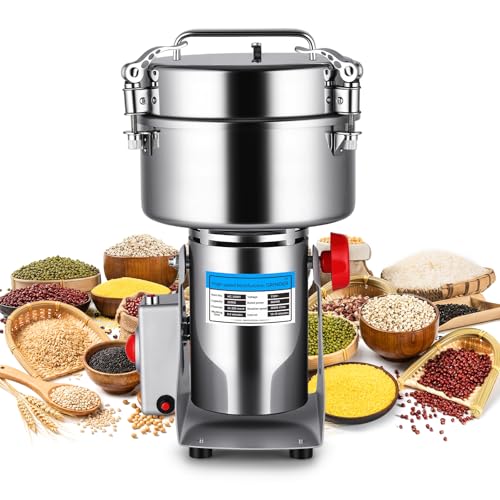
- 3000g chamber for high-volume batches
- 3600W motor with 36,000 RPM speed
- 30-300 mesh range and 270° swivel design
Best For: High-volume dry-grain milling at home or in a small café
Fast Fine-Grind Pick – Goldtouch 150g Electric Grain Mill
The Goldtouch 150g is a compact, high-speed option for shoppers seeking a grain mill for gluten free flour. Its 1500W motor and three-blade design are intended for dry grains, spices, coffee beans, and other dry ingredients, while the small capacity suits quick batches.
Best For: Home users who want fast grinding in small quantities and a versatile appliance for grains and spices.
Pros:
- 1500W motor and three-blade design for rapid grinding.
- Handles dry grains including wheat, corn, oats, and barley, plus spices.
- Interlock lid protection and overload protection add safety features.
- Includes a cleaning brush, spare blades, and spare carbon brushes.
Cons:
- 150g capacity is relatively small for larger flour-making sessions.
- Designed only for dry materials and requires cooling breaks after operation.
- The grinding chamber should be wiped or brushed rather than submerged.
This model is a practical choice when speed and versatility matter more than batch size. Follow the recommended operating and cooling intervals to support consistent use.
Premium Stone-Milling Choice – NutriMill Harvest Electric Stone Grain Mill
The NutriMill Harvest is a substantial stone mill for shoppers comparing a grain mill for gluten free flour. Its near-diamond-hard Corundum Grainmaster stones are designed to mill non-oily grains and legumes, with texture adjustment from pastry-fine flour to cracked grain.
Best For: Home bakers who want adjustable flour texture and a durable stone-milling design.
Pros:
- 450W motor with thermal protection and automatic shutoff.
- Corundum stones are designed to handle even hard grains.
- Patented Texture Control Knob adjusts from fine flour to cracked grain.
- 5-cup capacity supports larger home batches than compact mills.
Cons:
- At 18.7 pounds, it is substantially heavier than small countertop grinders.
- Intended for non-oily grains and legumes rather than a broad range of wet ingredients.
- Its premium stone-mill format may be more machine than occasional users need.
With its adjustable texture range and larger capacity, the Harvest is well suited to regular home milling. It is especially appealing if you value stone milling and control over flour consistency.
High-Capacity Power Pick – 750g Stainless Steel Grain Mill
The 750g OKF mill targets shoppers who need a high-capacity grain mill for gluten free flour. Its 2800W motor, 304 stainless steel construction, timer, and stated 70- to 300-mesh fineness range make it suited to demanding dry-grinding tasks.
Best For: Larger household, restaurant, or food-processing batches involving dry grains, spices, herbs, or coffee beans.
Pros:
- 750g capacity is suited to larger batches.
- 2800W motor and 28,000 rpm rotation speed support fast grinding.
- Timer function helps control grinding time and fineness.
- 304 food-grade stainless steel construction is sturdy and easy to wipe clean.
Cons:
- Continuous grinding should not exceed five minutes, followed by a cooling period.
- Only dry materials should be used, and the machine should not be rinsed directly with water.
- The 8.3-inch square footprint and 14-inch height require dedicated counter space.
This is the strongest capacity-oriented option in the group, particularly for users who need speed and adjustable grinding duration. Its operating limits and dry-only design should be part of your purchasing decision.
Traditional Manual Option – Stone Grain Mill with Wooden Stand
This manual stone mill offers a hands-on alternative for anyone seeking a grain mill for gluten free flour without an electric motor. Its stone grinding design is intended for dry or wet grinding of ingredients such as seeds, nuts, corn, and green beans, with a filter bag included for finer results.
Best For: Users who prefer manual, low-speed grinding and want to process selected wet or dry ingredients in a traditional-style mill.
Pros:
- Works for both dry and wet grinding according to the supplied notes.
- Manual operation avoids reliance on an electric motor.
- Includes a wooden frame, filter bag, and cleaning brush.
- Stone grinding and repeated passes are designed to produce a finer result.
Cons:
- Manual grinding requires substantially more time and effort than electric models.
- At 41.9 pounds, it is very heavy despite its relatively compact listed dimensions.
- Some ingredients, such as beans, require soaking before grinding.
This mill suits shoppers who value traditional preparation and flexibility with wet ingredients over speed. It is less practical for quickly producing large batches of flour.
Best for Easy Setup – 3000W 1000g Electric Grain Mill
If you need a grain mill for gluten free flour and other dry ingredients, this high-capacity stainless steel model is built for speed and larger batches. Its 3000W motor, 32,000 RPM speed, and adjustable 70–300 mesh range can process grains, beans, spices, coffee, herbs, and nuts.
Best For: Large households, busy kitchens, cafes, restaurants, and users who want one machine for flour and dry-food grinding.
Pros:
- Large 1000g capacity supports bigger grinding jobs.
- Powerful 3000W motor and 270° swing design promote fast, even results.
- Overload protection, a timer, and a secure-lock lid add useful safety features.
- Includes replacement blades, a screen, brush, and other accessories.
Cons:
- Requires a 5–10 minute rest after every 3 minutes of operation.
- Should not be filled beyond two-thirds of the chamber.
- Dry cleaning with a brush or cloth is recommended rather than washing the chamber.
This is the strongest choice of the three for frequent or high-volume gluten-free flour preparation, provided you are comfortable working in short cycles and maintaining the stainless steel chamber properly.
Most Versatile Home Option – 550g Adjustable Flour Mill
For shoppers seeking a grain mill for gluten free flour with flexible texture control, this 550g model offers 50–300 mesh adjustment and an 1800W motor. It is designed for dry, non-oily ingredients, including grains, legumes, seeds, spices, herbs, nuts, and coffee beans.
Best For: Home cooks who want adjustable flour texture and a versatile grinder for gluten-free baking, spice blends, coffee, and dry pantry ingredients.
Pros:
- Adjustable 50–300 mesh range accommodates coarse through ultra-fine results.
- 1800W motor and 25,000 RPM speed support quick grinding.
- Safety lid-lock, overload protection, and UL certification provide useful safeguards.
- Includes spare blades, carbon brushes, a sieve, brush, and socket wrench.
Cons:
- 550g capacity is smaller than the 1000g model.
- Limited to dry, non-oily food according to the supplied specifications.
- Its broad accessory and ingredient range may be unnecessary if you only mill flour.
This balanced model is a practical all-around pick when adjustable fineness matters more than maximum capacity. Its included replacement parts and one-year manufacturer warranty also support longer-term home use.
Compact Batch Pick – 150g Electric Grain Mill
This compact grain mill for gluten free flour is suited to small quantities of dry grains and pantry ingredients. Its 850W motor, 28,000 RPM speed, and 30–300 mesh range provide fine-grinding control, while the 150g chamber keeps the footprint and batch size modest.
Best For: Individuals, small households, and light commercial users who prepare small batches of flour, coffee, rice, spices, or cereal ingredients.
Pros:
- Compact 150g capacity works well for small, fresh batches.
- 30–300 mesh range supports coarse meal through fine powder.
- Three-layer blades are designed for even grinding in about one minute.
- Stainless steel construction, safety lock, and overload protection support routine use.
Cons:
- Small chamber requires repeated batches for larger flour needs.
- Operation should be limited to 3-minute cycles followed by 5–10 minutes of rest.
- Not suitable for wet or oily materials, and the grinding tank should be kept dry.
Choose this model when space and small-batch convenience are priorities. It offers useful fineness control for gluten-free flour, but its 150g capacity makes it less appropriate for frequent large-volume baking.
Fast Family-Batch Pick – 550g High-Speed Stainless Grain Mill
If you need a grain mill for gluten free flour that can handle everyday wheat, rice, corn, and other dry ingredients, this Yaofafa model emphasizes speed and a compact upright design. Its 550g chamber, 2000W motor, and adjustable 70-300 mesh range support both coarse and very fine results.
Best For: Home users who want fast small-to-medium batches of gluten-free flour, cornmeal, or spice powder.
Pros:
- Powerful 2000W motor reaches 28,000 RPM for quick grinding.
- Adjustable 70-300 mesh range offers coarse through superfine textures.
- 304 stainless steel chamber and blades avoid plastic contact with ingredients.
- Overload protection, locked-lid operation, and a non-slip base add safety.
Cons:
- The 550g capacity is smaller than the large-batch mills in this roundup.
- It is intended for dry ingredients only and requires cooling breaks between runs.
- The chamber should not be filled beyond two-thirds for best results.
This is a practical choice when speed and texture flexibility matter more than maximum capacity. The stainless construction and straightforward wipe-clean design also suit frequent kitchen use.
Compact Baking Specialist – NutriMill Impact Grain Mill
For shoppers seeking a grain mill for gluten free flour with a baking-focused design, the NutriMill Impact Compact centers on fine, consistent flour production. Its 1200-watt motor, stainless steel impact milling heads, and generous hopper and canister capacities make it suited to regular bread-flour preparation.
Best For: Frequent home bakers who want a compact mill for larger batches of fresh flour.
Pros:
- 1200-watt motor is designed to mill hard grains such as wheat.
- Impact milling heads target fine-textured, consistent bread flour.
- An 8-cup hopper and 12-cup flour canister support larger batches.
- Nesting parts and patented cyclone air filtration help with storage and airflow.
Cons:
- The supplied notes focus on bread flour rather than specifying a mesh adjustment range.
- Its white compact housing may offer less all-stainless construction than some alternatives.
- The product details list a 20-cup capacity without clarifying whether this refers to total system capacity.
The NutriMill is the more purpose-built option for bakers who prioritize a consistent fine texture and batch capacity. Its nesting design is useful when counter and cabinet space are limited.
Large-Batch Workhorse – 3000g 3600W Swivel Grain Mill
If production volume is your priority, this grain mill for gluten free flour offers a 3000g chamber and a 3600W motor. The Jivoxia model is designed for dry grains, beans, coffee, and spices, with a 30-300 mesh range and a 270-degree swivel intended to promote more even grinding.
Best For: Home users, small cafés, or other settings that need very large batches of dry gluten-free flour.
Pros:
- Large 3000g capacity can process substantial batches in one load.
- 3600W power and 36,000 RPM operation support rapid grinding.
- 30-300 mesh output range covers coarse to superfine powder.
- Overload shutoff, reset button, stainless body, and dual side buckles provide practical safety features.
Cons:
- The large 10.63-by-11.02-by-16.54-inch footprint needs considerable storage space.
- It must cool for 5-10 minutes after each maximum three-minute session.
- The notes contain inconsistent recommended-use details, so it is best to follow the dry-grain instructions.
This model stands out for capacity and power, making it appealing when smaller mills would require repeated batches. Its operating limits and no-water cleaning instructions are important for long-term use.
How We Picked the Best Grain Mill for Gluten Free Flour
We focused on mills suited to home users who want to process gluten-free grains and ingredients separately from wheat. The selection includes high-speed electric models, compact countertop grinders, a stone mill, and a manual option. We considered stated capacity, motor power, milling speed, construction materials, versatility, and the likely trade-offs between fine flour production and everyday convenience.
Specifications vary considerably across these products, and advertised wattage or RPM does not by itself guarantee better flour. Treat those figures as comparison points rather than a complete performance rating.
Quick Comparison
| Type | Best For | Main Advantage | Potential Trade-Off |
|---|---|---|---|
| Compact electric mill | Small kitchens and occasional batches | Easy storage and quick operation | Smaller capacity |
| High-capacity electric mill | Frequent baking or larger batches | Fewer refills | More space, noise, and cleanup |
| Stone grain mill | Traditional flour milling | Gentle, familiar milling method | May require more maintenance or effort |
| Manual mill | Off-grid use or low-volume grinding | No electricity required | Slower and more labor-intensive |
Key Buying Factors for a Grain Mill for Gluten-Free Flour
Ingredient Separation and Cleaning
If anyone in your household eats wheat, choose a mill that can be thoroughly emptied and cleaned. Removable milling parts, accessible chambers, and clear manufacturer cleaning instructions are especially important for reducing cross-contact risk. A dedicated mill is the safest approach for people with celiac disease or severe gluten sensitivity.
Capacity and Batch Size
Small 150g models can work well for a recipe or two, while 550g to 750g machines reduce interruptions for regular baking. Very large-capacity units make sense only if you have counter space, storage, and enough demand to use them regularly.
Control, Texture, and Ingredients
Look for useful speed or grind controls if you plan to mill rice, corn, sorghum, buckwheat, oats, or similar ingredients. Confirm that the product is intended for dry grains; wet grinding and oily ingredients may require a different attachment or cleaning process. A high-speed blade grinder may be versatile, but a dedicated stone or impact mill can offer more consistent flour texture.
Noise, Heat, and Durability
Powerful motors can finish batches quickly, but they may be loud and can warm the flour during extended operation. Stainless steel construction is practical for durability and cleanup. Also check duty-cycle guidance, cooling requirements, warranty coverage, and replacement-part availability.
Who Should Buy Which Grain Mill for Gluten Free Flour?
Choose a compact electric model if you have limited space, make modest quantities, or want freshly milled flour without a large appliance. Choose a higher-capacity, high-powered mill if you bake frequently and value fewer refills over quieter operation or easy storage.
Choose the stone mill if traditional milling and a countertop-focused workflow appeal to you. Choose the manual mill if electricity-free operation matters most and you are comfortable grinding smaller batches by hand. For households managing celiac disease, prioritize cleanability and dedicate the appliance to gluten-free ingredients rather than relying only on advertised speed or capacity.