When packaging hundreds or thousands of bags, a dependable sealer can improve throughput, reduce material waste, and create more consistent closures. The right machine depends on your bag material, production speed, seal width, and whether you need vacuum removal.
We selected 10 commercial and heavy-duty models, from compact manual impulse sealers to automatic continuous band machines with conveyors and digital controls. Use the guide below to match the machine to your workflow.
Best 10 Bag Sealing Machines for Large Batches Picks for 2026
Best Continuous Band Sealer

- Automatic sealing up to 16 m/min
- Adjustable 6–12 mm seal width
- Supports coding and nitrogen inflation
Best For: High-volume packaging with flexible sealing and coding needs
Best Wide-Bag Impulse Sealer

- 20-inch sealing length for large bags
- 3 mm bar for airtight sealing
- Handles plastic, foil, and composite materials
Best For: Manual bulk packaging with oversized bags
Best Coded Continuous Sealer

- Automatic conveying and sealing
- Prints dates, remarks, and times
- Speed adjusts up to 12 m/min
Best For: Lightweight production bags requiring package coding
Best Tabletop Manual Sealer

- 16-inch sealing length
- Eight adjustable timer levels
- Includes replacement parts and Teflon cloth
Best For: Small-batch food and household packaging
Industrial Continuous Sealer

- 0–12 m/min automatic continuous sealing
- 0–300°C temperature range and 6–12 mm seal width
- Extended conveyor supports items up to 5 kg
Best For: High-volume food and general packaging lines
Heavy-Duty Vacuum Sealer

- Double pump and cooling system support up to 450 consecutive seals
- 16-inch bar with wide 8 mm seal
- Works with smooth, textured, and Mylar bags
Best For: Commercial vacuum packing of varied foods
Commercial Conveyor Sealer
Continuous Band Sealer with Conveyor

- Seals continuously at up to 12 m/min
- 0–300°C temperature range with 6–12 mm seal width
- Includes transfer table and replacement components
Best For: Small commercial kitchens, bakeries, and shops
Precision Manual Pick
18-Inch Heavy-Duty Impulse Sealer

- Fine 3 mm seals for polished packaging
- Eight temperature settings for varied plastics
- Seal-and-cut design with replacement elements
Best For: Small businesses and light commercial packing stations
Production Workflow Pick
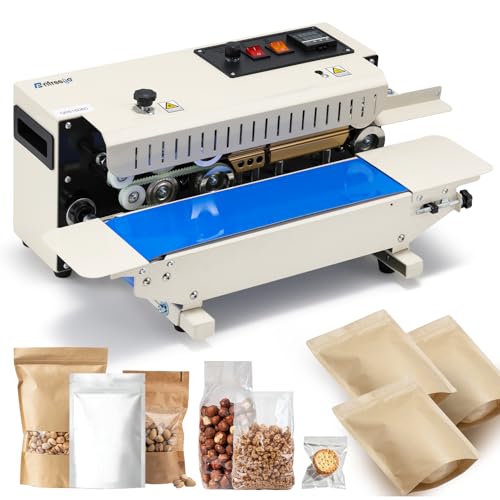
- Automatic continuous sealing for repeat workflows
- 0–300°C digital temperature adjustment
- Includes belts, fuses, and maintenance parts
Best For: Small production lines and food packaging operations
Conveyor Versatility Pick
Automatic Continuous Bag Sealer

- Built-in 6-inch conveyor for smooth feeding
- Works with plastic, foil, composite, and paper bags
- Adjustable speed and 6–12 mm sealing width
Best For: Small businesses handling varied bag materials and sizes
Best Continuous Band Sealer – VEVOR Automatic Bag Sealer
For bag sealing machines for large batches, this VEVOR continuous band sealer stands out with automatic operation, adjustable sealing widths, and speeds up to 16 m/min. Its 600W motor and carbon steel construction are suited to recurring commercial or household packaging work.
Best For: High-volume users who need adjustable sealing, coding, and optional nitrogen inflation.
Pros:
- Automatic continuous sealing with speed control up to 16 m/min.
- Adjustable 6–12 mm sealing width for different bag types.
- Supports embossing, alphanumeric printing, and nitrogen inflation.
- Includes replacement belts, a fuse, and other maintenance accessories.
Cons:
- The air tank for inflation is not included.
- At 48.5 pounds, it is less portable than a tabletop impulse sealer.
This is a strong choice when throughput and repeatable automatic sealing matter more than compact storage. Confirm that your bags fall within its supported thickness range and arrange a separate air tank if you need the inflation function.
Best Wide-Bag Impulse Sealer – 20-Inch Commercial Sealer
This 20-inch commercial impulse sealer is a practical option among bag sealing machines for large batches when you need a wide sealing bar for bulk packaging. Its manual impulse operation requires no warm-up and allows adjustment for different materials.
Best For: Factories, warehouses, and other operations sealing large bags or pouches with varied materials.
Pros:
- 20-inch sealing length accommodates large bags and bulk packaging.
- Extra-wide 3 mm sealing strip is designed for airtight seals.
- Works with PE, PP, foil, composite bags, and shrink wraps.
- Aircraft-aluminum body provides durability and heat dissipation.
Cons:
- Manual operation requires the operator to control each seal.
- It does not provide the automatic conveyor or coding functions of a band sealer.
Choose this model when bag width is the priority and operators can manage a manual workflow. Its compact 12.34-pound format is easier to position than heavier continuous machines, while the 20-inch bar handles larger packaging.
Best Coded Continuous Sealer – Automatic FR-900
The FR-900 is a useful pick among bag sealing machines for large batches when automatic conveying and package coding are important. It seals continuously at adjustable speeds up to 12 m/min while embossing or printing dates, remarks, and times.
Best For: Production lines that need automatic sealing with basic date or time marking.
Pros:
- Automatic sealing and conveying after the temperature is set.
- Adjustable sealing speed from 0 to 12 m/min.
- Embosses and prints dates, remarks, and times during sealing.
- Adjustable conveying angle accommodates different bag sizes.
Cons:
- Bag thickness is limited to 0.08 mm or less.
- Bag weight must not exceed 5 kg.
- The supplied notes do not specify a sealing-width limit, but compatibility should be checked for your packaging setup.
This machine makes the most sense for lightweight bags and operations that benefit from integrated marking. Its modular internal assembly and painted metal body also support routine maintenance, but heavier bags or thicker materials may require another model.
Best Tabletop Manual Sealer – 16-Inch Mylar Bag Sealer
For smaller bulk runs or workspaces that need a straightforward option, this 16-inch manual sealer offers a practical entry point among bag sealing machines for large batches. It uses an adjustable timer, a 3 mm seal, and a handle-activated sealing cycle.
Best For: Kitchens, farms, grocery settings, and small businesses sealing food, Mylar, poly, and foil bags.
Pros:
- 16-inch sealing length handles a range of household and commercial bags.
- Eight timer levels accommodate different bag materials and thicknesses.
- Supports plastic, Mylar, poly, foil, cookie, PE, and PP bags.
- Includes replacement wires, cutter wires, and Teflon cloth.
Cons:
- Manual pressing is slower and more labor-intensive than continuous sealing.
- Maximum seal thickness is 12 mils.
- The machine is limited to a 110V AC power source.
This compact 4.3-pound model is best for flexible, operator-controlled packaging rather than automated production lines. The included spare parts can help reduce interruptions during recurring sealing work.
Industrial Continuous Sealer – VONPACK FR-900
For bag sealing machines for large batches, the VONPACK FR-900 is built around continuous, automatic operation rather than one-bag-at-a-time sealing. Its adjustable speed, temperature, seal width, and extended conveyor make it a practical choice for repetitive packaging work.
Best For: High-volume sealing of food bags, snack bags, aluminum foil bags, and other compatible packaging.
Pros:
- Continuous sealing speed adjusts from 0–12 meters per minute.
- Temperature range of 0–300°C supports bags from 0.02–0.80 mm.
- Extended conveyor platform accommodates larger-volume items and carries up to 5 kg.
- Adjustable 6–12 mm sealing width suits varied packaging needs.
Cons:
- At 32.28 inches long and 17 pounds, it requires dedicated counter or workspace.
- Its 110V, 600W setup is more equipment than occasional household users may need.
The FR-900 stands out when throughput and workspace are priorities. Its conveyor and automatic band-sealing design make it especially suitable for production lines, kitchens, and other settings handling repeated batches.
Heavy-Duty Vacuum Sealer – MAGIC SEAL MS4005
Among bag sealing machines for large batches, the MAGIC SEAL MS4005 is the better fit when packaging also requires air removal. Its double pump, automatic cooling system, wide seal bar, and support for up to 450 consecutive seals suit demanding food-packing routines.
Best For: Commercial kitchens and users vacuum-sealing dry, wet, delicate, or Mylar-bagged foods in repeated batches.
Pros:
- Supports up to 450 consecutive seals without overheating, according to the supplied specifications.
- 16-inch bar seals bags up to 40 cm wide with an extra-wide 8 mm seal.
- Retractable-nozzle and chamber modes accommodate smooth and textured bags.
- Automatic and manual controls allow adjustment of vacuum pressure and sealing time.
Cons:
- Vacuum-sealing workflows are slower and more involved than simple heat-only band sealing.
- At 19.68 inches long, it needs a dedicated work area.
The MS4005 is a versatile batch vacuum sealer rather than a conveyor-style band sealer. Choose it when preserving food, handling moist or delicate items, or using Mylar bags matters as much as sealing throughput.
Commercial Conveyor Sealer – Continuous Band Sealer with Conveyor
If you need bag sealing machines for large batches in a kitchen, bakery, shop, or small production area, this commercial continuous band sealer provides automatic feeding and sealing at up to 12 meters per minute. Its broad temperature range and included maintenance parts support recurring packaging work.
Best For: Repetitive sealing of compatible food, bakery, kraft paper, aluminum foil, and CPP heat-sealable bags.
Pros:
- Automatic continuous operation reaches up to 12 meters per minute.
- 0–300°C adjustable temperature accommodates different compatible films and bags.
- 6–12 mm seal width provides setup flexibility.
- Includes a transfer table, spare sealing belt, replacement fuse, and other components.
Cons:
- Its 23-inch length and 27.1-pound weight may be substantial for limited counters.
- The supplied notes do not specify a maximum conveyor load.
This model offers the core features needed for steady, repeatable heat sealing without adding vacuum functions. It is a sensible option for small commercial operations that want conveyor-assisted batch packaging and useful replacement parts included.
Precision Manual Pick – 18-Inch Heavy-Duty Impulse Sealer
For buyers comparing bag sealing machines for large batches, this 18-inch manual impulse sealer offers a practical option when you need control over each package. Its 3 mm seal, eight temperature settings, and 3–5-second sealing cycle suit lighter commercial workflows, bakeries, coffee shops, and fulfillment tables.
Best For: Small businesses and workspaces that need a versatile manual sealer for snacks, coffee, tea, baked goods, and craft packaging.
Pros:
- Creates a fine 3 mm seal and uses less bag material than wider 8 mm models.
- Eight adjustable temperature settings support PE, PP, and other plastic bags.
- Seal-and-cut functionality and three replacement heating elements add flexibility.
- Steel construction, fuse protection, and an upgraded heat-dissipation plate support regular use.
Cons:
- Manual operation requires the operator to press the handle for every bag.
- The supplied notes position it for small-batch and light commercial use rather than fully automated production.
This is a strong fit when seal precision and material flexibility matter more than automation. Its 18-inch width accommodates larger bags, while the compact manual format keeps it practical for smaller packing stations.
Production Workflow Pick – 650W Continuous Band Sealer
For bag sealing machines for large batches, a continuous band design can reduce the need to stop and manually seal every package. This 650W commercial machine combines adjustable speed up to 12 m/min with digital temperature control from 0–300°C, making it suited to repeat packaging tasks.
Best For: Small production lines, bakeries, food businesses, and workspaces sealing plastic, kraft paper, or foil bags.
Pros:
- Automatic continuous operation supports higher-volume workflows than a manual impulse sealer.
- Adjustable speed and 0–300°C digital temperature control help tailor sealing to different materials.
- Steel construction and a discharge support plate help provide a durable, safer desktop setup.
- Includes toothed belts, a Teflon belt, backup fuses, and other maintenance accessories.
Cons:
- At 23 pounds, it is less portable than a compact manual sealer.
- The supplied details do not specify the maximum bag width or seal width.
This model is the more production-oriented choice in the group. Its continuous feed, speed adjustment, and included replacement components make it especially useful when consistent throughput and reduced maintenance interruptions are priorities.
Conveyor Versatility Pick – Automatic Continuous Bag Sealer
When evaluating bag sealing machines for large batches, this automatic continuous sealer stands out for its built-in conveyor and broad material compatibility. Adjustable speed, heat up to 300°C, and support for bags from 0.02 to 0.16 mm thick make it adaptable for ongoing packaging work.
Best For: Small businesses and home operators sealing plastic, aluminum foil, composite, and paper bags on a desktop packing station.
Pros:
- Automatic continuous operation helps maintain a steady packaging rhythm.
- Built-in 6-inch conveyor supports smooth feeding across different bag sizes.
- Adjustable 6–12 mm sealing width accommodates a range of packaging needs.
- Fast heat-up and temperatures up to 300°C support bags made from several materials.
Cons:
- Its 23-pound weight and 18.8-inch length require a dedicated workspace.
- The machine is specified for 110V/60Hz operation, so power compatibility should be checked.
This is a well-rounded option for buyers who want automated throughput without moving to a larger industrial system. The conveyor and adjustable sealing parameters provide useful control for varied small-business packaging tasks.
How We Picked the Best Bag Sealing Machines for Large Batches
We focused on the features that matter most in repetitive packaging work: sealing speed, temperature control, seal width, operating style, construction, and ease of adjustment. Continuous band sealers receive particular attention because they can process a steady stream of bags with less manual repositioning. We also included heavy-duty impulse models for businesses that need wider seals or more flexibility across bag sizes, plus a vacuum sealer for applications where air removal is essential.
Because capacity claims vary by material and operator technique, treat listed specifications as a starting point. Confirm compatibility with your actual bags, including polyethylene, polypropylene, foil laminates, Mylar, cookie bags, and other heat-sealable films.
Quick Comparison
- Best for automated throughput: FR-900-style continuous band sealers with digital controls and adjustable speed.
- Best for compact commercial work: Desktop continuous sealers that balance footprint, control, and output.
- Best for oversized or varied bags: 16- and 20-inch impulse sealers with adjustable temperature.
- Best for air-sensitive products: A commercial vacuum sealer with automatic cooling and a double-pump system.
- Best for supported bag handling: Continuous models equipped with a conveyor.
Key Buying Factors for Bag Sealing Machines for Large Batches
Continuous Versus Impulse Operation
Continuous band sealers are usually the better choice when bags arrive in a steady stream and consistent output matters. They feed and seal automatically, reducing operator fatigue. Impulse sealers activate only when the jaws close, making them useful for different bag sizes, thicker materials, intermittent production, and products that cannot travel easily through a band machine.
Seal Width, Temperature, and Speed
A wider seal can provide additional strength and tolerance for uneven film edges, while adjustable temperature helps prevent weak seals or melted packaging. Variable speed is valuable when changing between thin and heavy materials. Match the machine’s temperature range and seal width to your film supplier’s recommendations rather than choosing solely by wattage.
Workflow, Footprint, and Maintenance
For large batches, consider conveyor support, bag clearance, machine orientation, controls, and access to heating elements or belts. Digital displays can simplify repeatable settings across shifts. Also check replacement-part availability, cooling requirements, electrical compatibility, and whether the unit is suitable for your available bench or floor space.
Product Protection and Bag Compatibility
Vacuum sealing is different from ordinary heat sealing: it removes air before closing the bag and is useful for foods and other oxidation-sensitive products. For standard sealing, verify that the machine supports your film type and thickness. Never assume a sealer designed for thin plastic will handle foil laminates or heavy Mylar reliably.
Who Should Buy Which Bag Sealing Machines for Large Batches?
Choose an automatic continuous band sealer if you run a production line, fulfillment operation, bakery, or food-processing workflow with many similarly sized bags. A model with digital temperature control and adjustable speed is the most adaptable starting point.
Choose a wide manual impulse sealer if your batches contain mixed bag sizes, your workspace is limited, or you need to seal thicker or specialty materials one at a time. Select a conveyor-equipped machine when bag support and repeatable positioning are more important than portability.
Finally, choose a commercial vacuum sealer when extending freshness or limiting oxidation is a core requirement. Before buying, compare expected daily volume with the machine’s duty cycle, confirm the electrical requirements, and budget for consumables and replacement heating components.