The best bag sealing machines make it easier to protect food, organize supplies, and create cleaner-looking packages without relying on clips or tape. This roundup compares compact impulse sealers, tape sealers, mini handheld models, and continuous band machines.
Use the guide below to match sealing width, bag material, operating style, and production needs with the right machine for your workspace.
Best 10 Bag Sealing Machines Picks for 2026
Best Budget Impulse Sealer
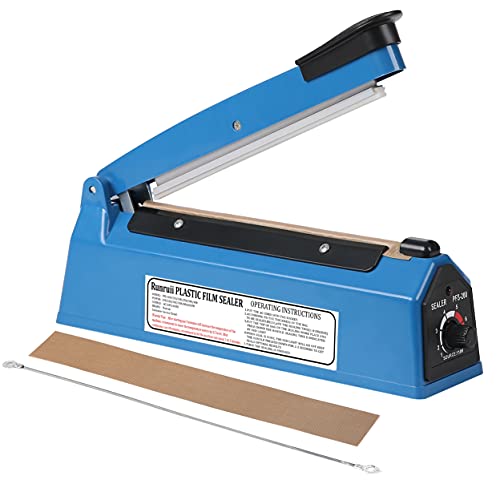
- No warm-up time
- Eight temperature settings
- Seals PE and PP bags
Best For: Household and small-business plastic bag sealing
Best for Ground Meat

- Twist-and-seal tape system
- Includes 216 feet of tape
- Cuts and seals in one motion
Best For: Freezer packaging for ground meat and wild game
Best Lightweight Tabletop Pick
METRONIC 12-Inch Impulse Sealer

- Weighs 1.2 pounds
- Adjustable temperature dial
- No warm-up time
Best For: Home bakers and small businesses
Best for Continuous Production

- Automatic conveyor operation
- Up to 16 m/min sealing speed
- In-line printing function
Best For: Higher-volume food, agricultural, and industrial packaging
Best Adjustable Tabletop Pick
METRONIC 8-Inch Impulse Sealer

- Adjustable heat for different bag materials
- No warm-up time required
- Sturdy iron construction for home or small-business use
Best For: Home bakers and small-scale product packaging
Best Portable 2-in-1 Pick

- Seals and cuts with one compact device
- Six adjustable heat settings
- Rechargeable battery with LED power display
Best For: Travel, camping, and everyday snack resealing
Best for Frequent Batch Sealing

- Eight temperature settings for PE and PP bags
- Instant-use impulse operation
- Built-in fuse and replacement element grip
Best For: Retail, produce, grocery, and recurring tabletop sealing
Best High-Output Pick
VEVOR 600W Continuous Band Sealer
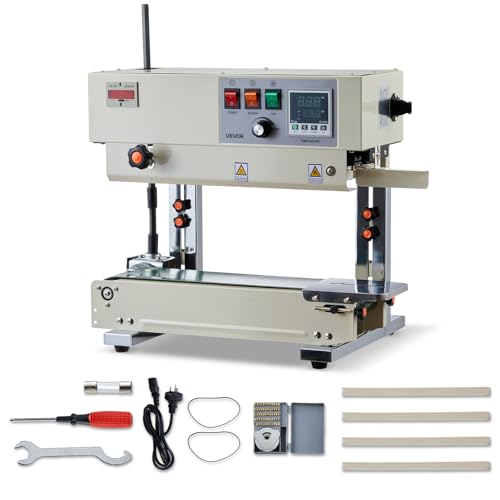
- Reaches up to 52.5 ft/min
- Adjustable seal width and temperature
- Adds printing and bag counting
Best For: Higher-volume packaging and production lines
Best Manual Value

- Seals bags up to 16 inches wide
- Eight timer settings for varied materials
- Includes sealing and cutting wire spares
Best For: Home, kitchen, retail, and small-batch packaging
Best Compact Automatic Pick
VEVOR Compact Continuous Sealer

- Runs up to 29.5 ft/min
- Handles plastic, kraft paper, and foil bags
- Includes temperature control and auto shutdown
Best For: Homes and small businesses with limited workspace
Best Budget Impulse Sealer – 12-Inch Manual Heat Sealer
This 12-inch manual heat sealer is a straightforward option among bag sealing machines for household, retail, grocery, and light industrial use. It requires no warm-up time, offers eight temperature settings, and seals PE and PP bags by pressing the handle for about 2–3.5 seconds.
Best For: Home users, produce sellers, grocery stores, and small operations sealing plastic bags individually.
Pros:
- No warm-up time is required.
- Eight temperature adjustments accommodate different bag materials.
- Compact 3.5-pound design with a built-in fuse.
- Includes an extra replacement element grip.
Cons:
- Manual operation requires holding the handle for each seal.
- It cannot cut bags.
- At 12 inches, the sealing width may not suit larger packages.
Choose this model when you want an uncomplicated, adjustable impulse sealer for moderate manual workloads. Its lack of a cutting function means bags must be trimmed separately.
Best for Ground Meat – LEM Poly Bag Tape Sealer
The LEM Poly Bag Tape Sealer takes a different approach to bag sealing machines, using a twist-and-seal tape system rather than heat. It wraps, seals, and cuts in one smooth motion, making it particularly useful for processing ground meat into freezer-ready poly bags.
Best For: Home processors, hunters, and small meat operations packaging ground pork, beef, wild game, or other meat for freezing.
Pros:
- Wraps tape around the bag, seals it, and cuts in one motion.
- Includes a 72-yard roll of 3/8-inch tape.
- The included roll can seal approximately 1,200 poly meat bags.
- Includes a one-year factory warranty and lifetime customer support.
Cons:
- Designed around poly bags and compatible tape rather than heat sealing.
- Manual operation may be slower for high-volume production lines.
- Its primary use case is food storage, especially meat packaging.
This is a focused choice for freezer-meat preparation rather than a general-purpose plastic heat sealer. The included tape and integrated cutting action help streamline repeated bagging tasks.
Best Lightweight Tabletop Pick – METRONIC 12-Inch Impulse Sealer
The METRONIC 12-inch impulse sealer is a lightweight option among bag sealing machines for cookies, coffee, bath bombs, and other small packaged goods. Its adjustable temperature dial and no-warm-up operation make it practical for home use and small businesses sealing PE and PP packaging.
Best For: Home bakers, craft sellers, and small businesses sealing food, bath products, and similar items.
Pros:
- Lightweight 1.2-pound tabletop design.
- Adjustable heat settings support different plastic materials.
- Requires no warm-up time.
- Designed to seal bags against airborne dust and help keep contents fresh and dry.
Cons:
- Sealing is manual and requires holding the handle for 3–5 seconds.
- The light and sealer activate only when the handle is pressed down.
- The 12-inch sealing width limits package size.
With its small footprint and simple controls, this METRONIC model suits occasional or moderate sealing tasks. It is a better fit for compact workspaces than for automated, continuous production.
Best for Continuous Production – VEVOR FR900K Band Sealer
The VEVOR FR900K is a continuous band sealer for buyers who need more throughput than manual bag sealing machines provide. It uses an automatic conveyor, adjustable speed and temperature controls, and a 6–15 mm seal width; its printing wheel can add dates, remarks, introductions, or logos during sealing.
Best For: Food, agricultural, pharmaceutical, and industrial packaging lines handling compatible plastic, foil, compound, or paper bags.
Pros:
- Automatic operation with sealing speeds up to 16 m/min.
- Digital temperature control and adjustable speed settings.
- Embossing and type wheels support in-line printing.
- All-metal carbon-steel construction with a DC copper motor.
Cons:
- Its 750-watt, 110-volt design is more substantial than a basic manual sealer.
- It is intended for continuous workflows rather than occasional household use.
- Compatible bag thickness is specified as 0.02–0.8 mm, so packaging must fall within that range.
This model is the strongest fit here for repeatable, higher-volume sealing and date or label marking. Its larger footprint and more involved controls make it best suited to a dedicated work area or production line.
Best Adjustable Tabletop Pick – METRONIC 8-Inch Impulse Sealer
The METRONIC 8-inch impulse sealer is a practical choice among bag sealing machines for home kitchens and small businesses. Its adjustable temperature dial lets you match the heat to different bag materials and thicknesses, while the manual design requires no warm-up time.
Best For: Home bakers, snack storage, bath-bomb packaging, and small-scale product sealing.
Pros:
- Adjustable temperature settings accommodate different plastic bags.
- 8-inch sealing width suits many household and small-business packages.
- Durable iron construction and copper coil are designed for extended use.
- Seals quickly without preheating and helps block dust and moisture.
Cons:
- Manual operation requires holding the handle down for roughly 3–5 seconds.
- Temperature and sealing time need adjustment to avoid melting thinner bags.
- Corded operation is less portable than a rechargeable model.
This is a solid tabletop option when you want adjustable heat and a sturdy build rather than a highly portable design. Start at a low temperature and test the material before sealing a full batch.
Best Portable 2-in-1 Pick – Rechargeable Mini Bag Sealer
This rechargeable mini bag sealer stands out among bag sealing machines for portability and convenience. It combines a heat sealer and cutter, includes six adjustable temperature gears, and uses an LED display to show remaining battery power.
Best For: Resealing snacks at home, travel, camping, and users who want a compact cordless tool.
Pros:
- Combines bag sealing and excess-material cutting in one handheld device.
- Six heat settings support thin snack bags, medium plastics, and thicker mylar bags.
- Rechargeable battery and LED power display reduce reliance on disposable batteries.
- Lightweight design is easy to carry and store.
Cons:
- Manual handheld operation may be less convenient for sealing large batches.
- Battery-powered use requires recharging.
- Its compact format is aimed at everyday bags rather than heavy-duty production work.
Choose this model when portability, cutting, and quick snack-bag resealing matter most. The six temperature gears add flexibility, while the rechargeable design makes it especially useful outside the kitchen.
Best for Frequent Batch Sealing – 8-Inch Impulse Heat Sealer
The 8-inch impulse heat sealer is a practical option among bag sealing machines for household, retail, produce, grocery, and light industrial packaging. Its eight temperature settings support PE and PP bags, and the impulse design heats only when the sealing arm is pressed.
Best For: Retailers, produce sellers, grocery use, and users sealing multiple plastic bags regularly.
Pros:
- Eight temperature settings help accommodate different plastic materials.
- No warm-up time is needed, supporting faster manual workflows.
- Impulse heating is designed to conserve energy because the element is not constantly heated.
- Includes a built-in fuse and an extra replacement element grip.
Cons:
- Manual sealing requires holding the handle for about 2–3.5 seconds.
- Corded operation limits portability.
- Requires careful cleaning; the supplied notes advise against using a damp cloth on the surface.
This model makes sense for users who need repeatable tabletop sealing with adjustable heat and an energy-saving impulse operation. It offers a more work-oriented format than a handheld resealer while remaining manually operated.
Best High-Output Pick – VEVOR 600W Continuous Band Sealer
For higher-volume packaging, this VEVOR continuous band sealer is one of the more capable bag sealing machines in this roundup. Its 600W motor reaches up to 52.5 ft/min, while adjustable temperature, sealing width, printing, and a built-in counter add production-line flexibility.
Best For: Warehouses, bakeries, workshops, shops, and other settings that need fast, repeatable sealing with optional date or batch marking.
Pros:
- Seals at speeds up to 52.5 ft/min with a 600W motor.
- Adjustable 0.24–0.47-inch seal width supports varied bag sizes.
- Supports printing and includes a real-time bag counter.
- Includes replacement belts, a fuse, and embossing wheel accessories.
Cons:
- At 28 pounds, it is less portable than a manual impulse sealer.
- Its larger footprint may be excessive for occasional home use.
This is the strongest choice when throughput and added packaging functions matter more than compactness. Choose it for ongoing production rather than infrequent sealing tasks.
Best Manual Value – 16-Inch Impulse Heat Sealer
This 16-inch impulse sealer is a straightforward option for shoppers who want practical bag sealing machines without a continuous-feed setup. Its manual handle, eight timer levels, 3 mm seal, and included replacement wires make it suitable for a range of household and retail packaging jobs.
Best For: Home kitchens, grocery and retail use, mylar or foil bags, produce, candy, coffee, cookies, and other occasional or small-batch sealing.
Pros:
- Provides a 16-inch maximum seal length for larger bags.
- Eight adjustable timer levels accommodate different bag materials and thicknesses.
- Includes flat sealing wires and round cutting wires as replacement parts.
- Automatic power cut-off follows the approximately 1–3.5-second sealing cycle.
Cons:
- Manual operation requires pressing the handle for every seal.
- It does not provide continuous band-sealing speed for production lines.
- The 3 mm seal is narrower than some adjustable-width band sealers.
Its iron housing and generous 16-inch sealing length make this a useful general-purpose choice. It is especially appealing when affordability and occasional flexibility matter more than automation.
Best Compact Automatic Pick – VEVOR Compact Continuous Sealer
For smaller workspaces, this compact VEVOR continuous sealer offers an efficient middle ground among bag sealing machines. The 400W unit runs up to 29.5 ft/min, accepts plastic, kraft paper, and foil bags, and combines digital temperature control with automatic shutdown.
Best For: Homes, bakeries, small shops, workshops, and sellers packaging candy, bread, cookies, or similar products.
Pros:
- Compact 10.7-pound design is easier to place and move than larger models.
- Runs continuously at speeds up to 29.5 ft/min.
- Supports adjustable 0.32–0.47-inch seals and multiple bag materials.
- Covered heating zone and 122°F automatic shutdown add convenience.
Cons:
- Its 29.5 ft/min speed is lower than the larger 600W VEVOR model.
- It is listed as semi-automatic rather than fully automatic.
- It does not include the printing and counting features of the higher-output model.
This model makes sense when you need continuous sealing but have limited space or moderate packaging volume. Its protective design and compact build are particularly useful for home-based or small-business use.
How We Picked These Bag Sealing Machines
We selected machines across the main categories buyers are likely to consider: manual impulse sealers, tape-based poly bag sealers, handheld mini sealers, and continuous band sealers. The lineup includes 8-, 12-, and 16-inch sealing widths, plus horizontal and vertical designs for different packaging setups.
Our comparison emphasizes practical buying criteria: compatibility with common PE and PP bags, seal width, temperature control, operating speed, portability, replacement parts, and whether a model suits occasional household use or repeated packaging work. Continuous machines can improve throughput, while impulse models are generally simpler, more compact, and easier to store.
Quick Comparison
| Machine type | Best for | Main advantage | Potential limitation |
|---|---|---|---|
| Impulse heat sealer | Home storage and light packaging | Simple operation and compact size | Requires manual positioning for every bag |
| Tape sealer | Closing poly bags without heat | Fast, inexpensive bag closure | Not an airtight heat seal |
| Mini bag sealer | Occasional snack and household use | Portable and easy to keep in a drawer | Limited sealing capacity and control |
| Continuous band sealer | Frequent or commercial-style packaging | Consistent automated sealing | Larger footprint and higher cost |
Key Buying Factors for Bag Sealing Machines
Bag Material and Thickness
Check the machine’s stated compatibility before buying. Many heat sealers are designed for PE and PP bags, while specialty films such as thicker laminated pouches or Mylar may require suitable temperature range and sealing pressure. A machine that is too cool may leave a weak seal; excessive heat can damage thin film.
Sealing Width
Choose a sealing bar that is at least as wide as the opening you need to close. An 8-inch model works well for smaller portions, while 12- and 16-inch machines accommodate wider bags. Leave enough material beyond the contents to position the bag flat across the bar.
Impulse or Continuous Operation
Impulse sealers heat only when the bar is engaged, which helps reduce energy use and makes them practical for intermittent jobs. Continuous band sealers feed bags through the machine and are better suited to repeated packaging, consistent output, and higher volumes.
Temperature, Speed, and Controls
Adjustable temperature is useful when sealing different films or thicknesses. Continuous models may also provide speed control, allowing you to balance production rate with seal quality. Digital controls can make settings easier to repeat, but they may add complexity compared with a basic manual unit.
Maintenance and Replacement Parts
Heating elements, PTFE tape, cutters, and other wear components eventually need replacement. Favor models with clearly identified replacement parts, especially if you expect frequent use. Keep the sealing surface clean and avoid trapping product residue in the bar.
Who Should Buy Which Bag Sealing Machines?
For Occasional Household Storage
Choose a compact 8-inch impulse sealer or mini bag sealer for snacks, frozen food, craft materials, and general organization. These models take up little space and are adequate for short, intermittent sealing jobs.
For Wider Bags and More Flexibility
A 12-inch or 16-inch impulse sealer is a better fit for larger bags, bulk ingredients, clothing, or storage materials. Look for adjustable heat and included replacement components if you want more control and longer service life.
For Quick Poly-Bag Closure
A tape sealer is worth considering when you need to close retail or storage bags quickly but do not require an airtight or moisture-resistant heat seal.
For Frequent Packaging
Choose a continuous band sealer when you package many bags in one session. Horizontal designs are convenient for stable, lightweight items, while vertical configurations can better accommodate liquid, granular, or heavier contents. Before purchasing, confirm the supported bag thickness, seal width, power requirements, and available workspace.